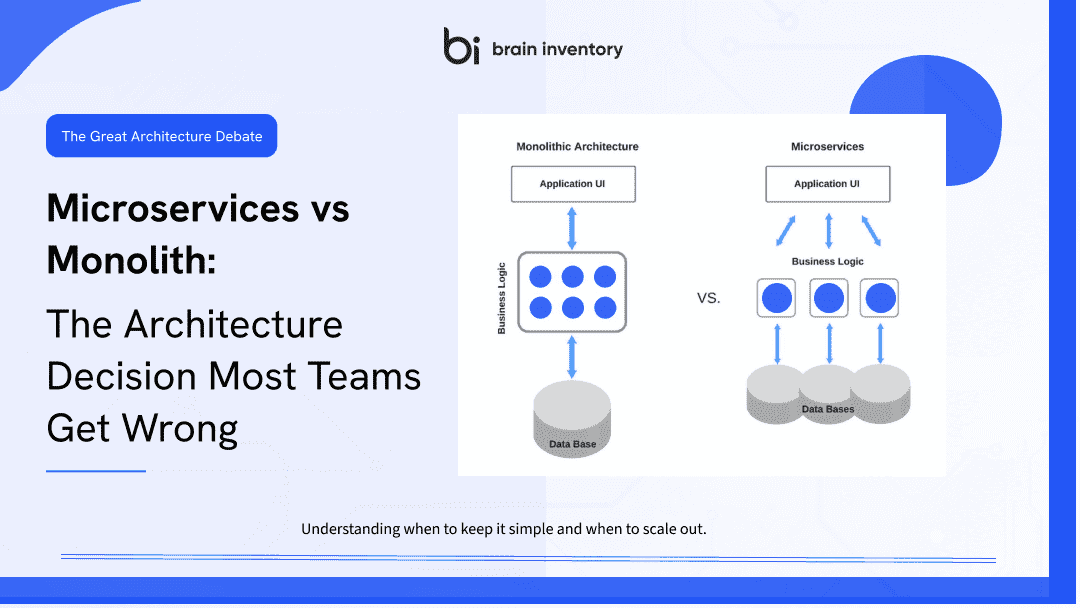
For years, microservices have been positioned as the ultimate evolution of software architecture. Whether the goal is improving scalability, accelerating deployments, or building a modern SaaS platform, the recommendation often sounds the same: adopt microservices. Over time, this architectural pattern has become so widely accepted that many engineering teams rarely stop to ask whether it is actually the right fit for their product. Instead, microservices have gradually shifted from being a solution for specific engineering challenges to becoming the default choice for building modern applications.
The problem is that many organizations don’t actually have a monolith problem. They have a complexity problem. Splitting one application into twenty independent services doesn’t eliminate that complexity; it simply redistributes it across APIs, deployment pipelines, containers, monitoring tools, and services that all need to communicate reliably to complete a single business operation.
As a result, teams often spend months decomposing a perfectly functional application only to discover that deployments are more complicated, debugging takes longer, and understanding the overall system has become significantly harder. The issue isn’t that microservices architecture is inherently flawed. It’s that many teams adopt it long before they reach the scale where its benefits outweigh its costs.
When “Modern” Became the Default
Like every technology trend, software architecture has gone through its own cycles of popularity. A few years ago, serverless computing dominated technical conversations. Today, artificial intelligence commands most of the industry’s attention. Before either of those, Kubernetes became synonymous with modern infrastructure. Somewhere during that evolution, microservices also became less of an architectural choice and more of an expectation.
It’s easy to understand why. Companies like Netflix, Amazon, and Uber have openly shared how distributed systems helped them scale massive engineering organizations while serving millions of users across the globe. Their success stories inspired countless startups to follow a similar path, assuming that adopting the same architecture would automatically prepare them for future growth.
However, there’s an important detail that’s often overlooked. These companies didn’t begin with hundreds of independent services. They introduced microservices only after their businesses, engineering teams, and deployment requirements had grown beyond what a single codebase could comfortably support. In other words, the architecture evolved because the business demanded it.
Today, many startups reverse that sequence. They replicate enterprise architectures on day one and hope their product eventually grows into them. Unfortunately, architecture rarely creates scale on its own. More often, it introduces complexity that the team isn’t yet equipped to manage.
The Question Most Teams Never Ask
When discussing microservices vs monolith, the conversation usually focuses on the benefits of distributed systems. Independent deployments allow teams to release features without waiting for large application-wide deployments. Individual services can scale independently based on demand, and failures are often isolated more effectively than they are in a single application. These are genuine advantages and one of the primary reasons microservices have become the preferred architecture for many enterprise systems.
However, these benefits only tell part of the story.
A much more important question is what your engineering team has to manage in exchange for those advantages. Every new service introduces another deployment pipeline, another repository, another API, another monitoring dashboard, another set of logs, and another production dependency.
Although the application is divided into smaller codebases, the overall system becomes significantly larger and more difficult to operate. That’s the trade-off many architecture diagrams fail to illustrate.
You’re Not Splitting Code. You’re Splitting Responsibility
One of the biggest misconceptions surrounding microservices architecture is that the primary goal is dividing an application into smaller pieces of code. In reality, what you’re really dividing is ownership. Every service becomes an independent software product with its own deployment process, infrastructure, security requirements, testing strategy, and operational lifecycle.
This shift fundamentally changes how software is built and maintained. A database call that once happened inside a single application becomes a network request between services. A simple function call evolves into an API contract that multiple teams depend on. Debugging an issue is no longer limited to tracing one application; it may require investigating several services, asynchronous message queues, deployment histories, and logs distributed across different systems.
As organizations embrace distributed systems, concepts such as observability, distributed tracing, fault tolerance, service discovery, API gateways, and centralized monitoring stop being advanced engineering practices and become operational necessities.
- Observability helps teams understand what is happening across distributed services.
- Distributed tracing helps track requests across multiple services.
- Fault tolerance helps systems continue operating when individual components fail.
- Service discovery helps services locate and communicate with one another.
- API gateways can provide a controlled entry point into distributed services.
- Centralized monitoring helps teams identify system-wide problems.
- Automated CI/CD becomes increasingly important as the number of independently deployed components grows.
These capabilities aren’t optional additions to a microservices ecosystem; they’re what allow the platform to remain reliable as complexity increases.
Microservices don’t eliminate complexity. They simply move much of that complexity from the application itself into the infrastructure required to keep distributed services running efficiently.
The Architecture Most Teams Skip
The discussion around microservices vs monolith often creates the impression that there are only two architectural choices available. In reality, experienced engineering teams frequently adopt a third approach that combines the simplicity of a monolith with the maintainability of well-structured software: the modular monolith.
A modular monolith isn’t simply a smaller version of a traditional monolith. Instead, it’s an application intentionally divided into independent modules with clearly defined responsibilities, boundaries, and ownership. Although everything is deployed as a single application, each module is designed to minimize dependencies and communicate through well-defined interfaces.
This structure allows development teams to maintain a clean architecture without immediately introducing the operational complexity of distributed systems.
For many startups and growing SaaS products, this approach offers the best of both worlds. Teams can continue shipping features quickly, avoid the infrastructure overhead associated with multiple services, and still build a codebase that’s prepared for future growth.
When a particular module eventually needs to become an independent service, the transition is significantly easier because the architectural boundaries already exist.
In many successful software products, the best microservices don’t begin as services at all—they begin as well-designed modules inside a thoughtfully organized monolith.
Benefits of a Modular Monolith
- Faster development cycles
- Lower infrastructure overhead
- Simpler deployment processes
- Easier debugging
- Clearer application boundaries
- Less operational complexity
- A potential path toward future service extraction
The Most Expensive Mistake Isn’t Choosing a Monolith
Choosing a monolithic architecture rarely becomes the biggest engineering mistake. Choosing microservices before your business is ready often does.
This usually leads to an architectural anti-pattern known as the distributed monolith. On the surface, it appears modern because the application has been split into multiple services with separate repositories and deployment pipelines. In reality, however, those services remain tightly coupled.
Deploying one service may require changes in another, APIs can become heavily dependent on one another, and teams may continue sharing the same database because separating data feels too risky or expensive.
Common Signs of a Distributed Monolith
- Deploying one service requires changes in another.
- APIs become heavily dependent on each other.
- Multiple services share the same database.
- Releases require coordination across several teams.
- A simple feature requires changes across multiple services.
- Debugging requires tracing several applications and infrastructure components.
- Services cannot be deployed or changed independently.
Instead of gaining the independence that microservices architecture promises, organizations inherit all the operational overhead of distributed systems while retaining many of the limitations of a traditional monolith.
A simple feature request can suddenly require multiple deployments, coordinated releases across different teams, and lengthy debugging sessions involving services scattered throughout the platform.
The underlying issue isn’t the technology itself. It’s how service boundaries were designed.
Successful microservices are built around business capabilities rather than technical layers, which is where Domain-Driven Design (DDD) becomes especially valuable. By defining clear bounded contexts and assigning ownership to specific business domains, engineering teams create services that can evolve independently without constantly relying on one another.
Without these boundaries, organizations don’t create independent services—they simply distribute complexity across multiple applications.
Your Architecture Should Mirror Your Business, Not Industry Trends
One of the most influential concepts in software architecture is Conway’s Law, which states that software systems naturally reflect the communication structure of the organizations that build them. While the principle sounds simple, its implications are significant.
Small engineering teams often perform exceptionally well with a monolithic architecture because collaboration is fast, communication happens naturally, and everyone understands the application as a whole.
As companies grow, however, engineering teams become more specialized. Ownership shifts between multiple groups, release schedules become independent, and coordination across departments becomes increasingly challenging.
At that stage, microservices begin solving organizational problems as much as technical ones. Independent deployments, autonomous teams, and clearly defined service ownership become valuable because they support the way the business now operates.
This highlights an important insight that is often overlooked in discussions about software architecture. Applications rarely need microservices before organizations do.
In many cases, businesses scale people before they need to scale systems.
Migration Should Be Evolution, Not Revolution
Another common misconception is that moving from a monolith to microservices requires rebuilding an entire application from scratch. In practice, the most successful organizations rarely approach migration this way.
Instead, they evolve their architecture gradually using strategies such as the Strangler Fig Pattern.
Rather than replacing the entire application in one high-risk project, individual modules are extracted into independent services over time as business requirements change. The existing monolith continues operating while new capabilities are introduced incrementally, allowing teams to validate architectural decisions without disrupting the entire platform.
Benefits of an Evolutionary Migration
- Reduced technical migration risk
- Preserved business continuity
- Incremental validation of architectural decisions
- Gradual development of operational maturity
- Better identification of components that genuinely benefit from independent deployment
- Less disruption to existing customers and business operations
This evolutionary approach reinforces an important principle:
Software architecture should evolve alongside the product rather than attempting to predict years of future growth on day one.
Choosing Between Microservices and a Monolith
There isn’t a universal winner in the microservices vs monolith debate because both architectural styles are designed to solve different problems.
When a Monolith or Modular Monolith Makes Sense
If your team is building an MVP, validating product-market fit, or managing a relatively small engineering organization, a well-structured monolith—or preferably a modular monolith—can deliver faster development cycles with significantly lower operational overhead.
A monolith or modular monolith may be appropriate when you have:
- A small engineering team
- An early-stage product
- Rapid product experimentation
- Limited operational resources
- Relatively straightforward scaling requirements
- A need for simple deployments and debugging
The simplicity of a single deployment, centralized logging, and easier debugging often outweighs the flexibility offered by distributed services during the early stages of growth.
When Microservices May Become Appropriate
Organizations managing multiple engineering teams, frequent deployments, independently scalable workloads, and mature DevOps practices are more likely to have requirements that microservices can address.
Relevant conditions may include:
- Multiple autonomous engineering teams
- Services with significantly different scaling requirements
- Frequent independent releases
- Clearly defined business domains
- Mature CI/CD practices
- Strong observability and monitoring capabilities
- Established DevOps and platform engineering practices
At that point, investments in observability, distributed tracing, API gateways, container orchestration with Kubernetes, and automated CI/CD pipelines become increasingly important because they support an ecosystem operating at scale.
Microservices vs Monolith: Key Takeaways
- Microservices aren’t automatically more scalable.
Scalability depends on architecture, workloads, infrastructure, and system design. - Distributed systems introduce operational complexity.
APIs, networking, observability, deployments, and monitoring become critical. - Modular monoliths are a legitimate architectural strategy.
They can provide strong boundaries without immediately introducing distributed-system overhead. - Service boundaries matter more than service count.
Poorly designed boundaries can create a distributed monolith. - Architecture should reflect business needs.
Team structure, ownership, deployment requirements, and product complexity all matter. - Migration doesn’t have to happen all at once.
Incremental approaches such as the Strangler Fig Pattern can reduce risk. - Architecture should evolve.
The system you need today may not be the system you need several years from now.
Final Thoughts
Software architecture should never be treated as a measure of engineering maturity. It’s a series of trade-offs that balance simplicity, scalability, maintainability, and operational complexity.
Microservices have transformed the way many large organizations build software, but they are not a shortcut to scalability. Without clear service boundaries, strong operational practices, mature DevOps processes, and thoughtful system design, they often introduce more challenges than they solve.
For many businesses, the smartest architectural decision isn’t choosing between a monolith and microservices. It’s choosing the architecture that aligns with the current stage of the product, the size of the engineering team, and the complexity the organization is genuinely ready to manage.
The best architecture isn’t the one that follows industry trends. It’s the one your team can confidently build, maintain, and evolve as your business grows.
Need Help Choosing the Right Software Architecture?
Choosing between a monolith, modular monolith, and microservices architecture can have long-term implications for your product, engineering team, infrastructure, and development costs.
Brain Inventory helps businesses and engineering teams plan, build, modernize, and scale software products with practical technology strategies aligned with real business requirements.
Whether you’re building a new SaaS product, modernizing an existing application, or considering a migration from a monolith to microservices, getting the architecture right can help you avoid unnecessary technical complexity later.
Let’s discuss your product, technical challenges, and architecture requirements.