Retrieval-Augmented Generation (RAG): The AI Upgrade That’s Making Answers More Reliable
Artificial intelligence has become incredibly good at answering questions, writing content, generating code, and even helping businesses automate everyday tasks. Because of that, it’s easy to assume that modern AI knows almost everything.
It doesn’t.
The biggest strength of AI isn’t knowing every answer. It’s recognizing when it needs more information before responding.
That’s an important distinction because most AI models don’t struggle with intelligence. They struggle with access to information. Every day, businesses update policies, launch products, publish new research, revise documentation, and generate thousands of new records. Unless an AI system is connected to those sources, it has no way of knowing those changes have happened.
This is why you can ask two AI assistants the exact same question and receive completely different answers. One might confidently quote an outdated company policy, while the other provides the latest version along with the document it came from. The difference isn’t that one model is dramatically smarter than the other. It’s that one of them can retrieve the right information before generating a response.
This is exactly what Retrieval-Augmented Generation (RAG) is designed to do. Instead of relying entirely on what a language model learned during training, RAG allows it to search trusted sources, retrieve relevant information, and then use that information to answer your question. The model still does the reasoning, but now it does so with the right context.
As businesses continue adopting AI, this approach is quickly becoming one of the most effective ways to improve accuracy without rebuilding AI models from scratch.
Why AI Gets Things Wrong
One of the most common misconceptions about artificial intelligence is that it works like an always-updated encyclopedia. In reality, that’s not how most AI systems function.
Most AI assistants are powered by Large Language Models (LLMs) that learn from enormous collections of text during training. They recognize patterns, understand relationships between words, and learn how people communicate. That’s what enables them to summarize reports, answer questions, write emails, and even generate software code.
However, training has a finishing point.
Once a model has completed training, it doesn’t automatically learn about new events, updated company documents, policy changes, or newly published research. Unless someone retrains the model or provides additional information, its knowledge remains limited to what it had already learned.
Think of it like a professional who graduated several years ago. They may have a strong understanding of their field, but if they never read another book, attended another workshop, or kept up with industry updates, their knowledge would slowly become outdated.
Large Language Models face the same challenge.
Suppose your company updates its employee handbook this morning or changes the pricing of one of its products tomorrow. A standalone AI model won’t know those updates exist. When someone asks about them, the model attempts to generate the most likely answer based on what it already knows.
Sometimes that prediction is correct.
Sometimes it isn’t.
And because language models are designed to sound natural and confident, an incorrect answer can still appear completely believable.
These inaccurate responses are known as AI hallucinations, and they’re one of the biggest reasons organizations remain cautious about using AI for tasks where accuracy is essential. Whether it’s customer support, healthcare, finance, legal services, or internal knowledge management, businesses need answers they can trust.
So how do you make AI more reliable without constantly retraining the model every time information changes?
That’s where Retrieval-Augmented Generation comes in.
What Is Retrieval-Augmented Generation (RAG)?
Despite its technical name, the idea behind Retrieval-Augmented Generation is surprisingly straightforward.
Imagine asking two colleagues the same question about a recently updated company policy. One answers entirely from memory, while the other quickly checks the latest handbook before responding. Even if both colleagues are equally experienced, you’re far more likely to trust the second answer because it’s based on the most current information.
RAG applies the same principle to AI.
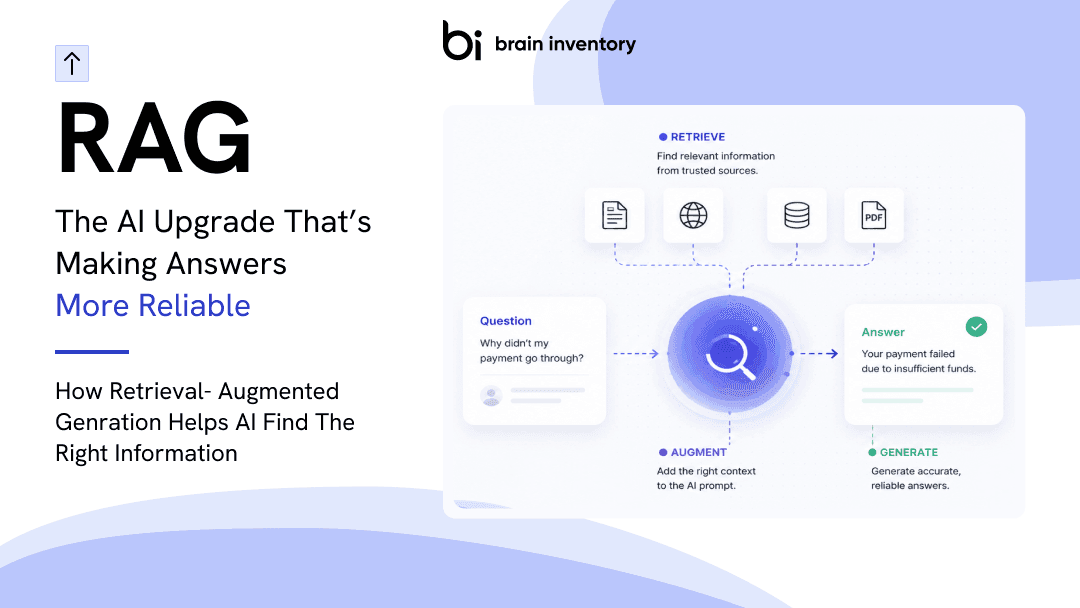
Before generating a response, the AI searches trusted sources such as company documents, internal knowledge bases, websites, research papers, PDFs, or databases to find information related to your question. It then passes that information to the language model, which uses it as context while generating its answer.
Rather than replacing what the model already knows, RAG enhances it. The language model still understands language, reasons through the problem, and generates a natural response. The difference is that it’s working with reliable, up-to-date information instead of relying only on memory.
This is why RAG-powered AI is becoming the preferred choice for businesses that need accurate and trustworthy answers.
How Does Retrieval-Augmented Generation Work?
Although the technology behind RAG involves several advanced AI techniques, the overall process is much easier to understand than most people expect.
It begins the moment you ask a question.
Instead of immediately generating an answer, the system first searches the documents and knowledge sources connected to it. Unlike a traditional search engine that mainly looks for matching keywords, RAG uses semantic search, which focuses on understanding the meaning behind your question.
For example, imagine asking, “Why didn’t my payment go through?”
The document containing the answer might actually say, “The transaction couldn’t be completed because of insufficient funds.”
A traditional keyword search may overlook that document because the wording is different. Semantic search recognizes that both sentences describe the same situation and retrieves the relevant information anyway.
Once the most relevant content has been found, it is added to the AI’s prompt. The language model then combines its own understanding of language with the retrieved information to generate a response that is both conversational and grounded in reliable sources.
From a user’s perspective, the entire process happens in just a few seconds. Behind the scenes, however, that additional retrieval step makes a significant difference. Instead of producing an answer based only on probability, the model generates a response supported by current and relevant information.
That simple change is one of the biggest reasons modern AI systems are becoming more dependable in real-world business applications.
Why Businesses Are Choosing RAG
Information is one of the most valuable assets a business has, but it’s also one of the fastest-changing. Product documentation is updated, support articles are rewritten, compliance rules evolve, pricing changes, and new policies are introduced regularly. If an AI assistant can’t keep up with those changes, its answers quickly become outdated.
Retraining a Large Language Model every time new information is created isn’t practical. It’s expensive, time-consuming, and often unnecessary. Businesses need a solution that allows AI to work with the latest information without rebuilding the model itself.
That’s exactly what Retrieval-Augmented Generation offers.
Instead of updating the model every time something changes, organizations simply update their knowledge base. The next time someone asks a question, the AI retrieves the latest information before generating its response. This approach makes AI easier to maintain, less expensive to operate, and far more useful in environments where information changes frequently.
Where You’re Already Using RAG
Even if you’ve never heard the term Retrieval-Augmented Generation before, you’ve probably interacted with it.
Many AI-powered customer support platforms use RAG to answer questions based on the latest product documentation and help articles. Enterprise search tools rely on it to help employees find information across thousands of internal documents. AI assistants can summarize PDFs you’ve uploaded because they retrieve information directly from the file instead of relying on what they learned during training.
The same approach is also being used in healthcare, where AI can reference updated medical guidelines, in legal services where it searches contracts and regulations, and in software development where coding assistants retrieve information from technical documentation.
These AI systems don’t feel more capable because they use larger language models.
They feel more reliable because they’re connected to the information people actually need.
RAG vs. Fine-Tuning
As businesses explore AI, another term often comes up alongside RAG: fine-tuning. While the two are frequently mentioned together, they solve different problems.
Fine-tuning changes the behavior of a language model. It’s useful when you want AI to follow a particular writing style, understand industry-specific terminology, or perform a specialized task more effectively.
RAG takes a different approach.
Instead of changing the model, it changes the information available to the model.
Think of it like onboarding a new employee. You don’t send them back to university every time your company updates a policy. You simply give them access to the latest handbook and internal documentation. From that point on, they can answer questions using the most recent information.
RAG works in much the same way. The model remains the same, but the knowledge it can access continues to grow. For businesses that regularly update their information, this is often a far more practical solution than retraining an AI model every few weeks.
What Makes RAG Better Than Traditional Search?
Most people assume RAG is simply a smarter search engine, but there’s an important difference.
A traditional search engine helps you find documents.
RAG helps AI find the right information inside those documents and then uses it to answer your question.
This is possible because of technologies like semantic search, embeddings, and vector databases.
Although these terms sound technical, the idea is simple. Instead of matching exact words, the AI searches based on meaning.
For example, someone might ask, “Why was my payment declined?” while the document says, “The transaction failed because of insufficient funds.”
Even though the wording is different, the AI understands that both refer to the same issue and retrieves the relevant information.
This ability to understand context rather than exact wording is what makes RAG feel much more natural than a traditional keyword search. Instead of presenting a list of documents for you to read, it brings together the relevant information and explains it in a conversational way.
Can RAG Completely Eliminate Hallucinations?
RAG significantly improves the reliability of AI, but it isn’t a perfect solution.
The quality of an answer still depends on the quality of the information being retrieved. If the connected documents are outdated, incomplete, or inaccurate, the AI can still produce an incorrect response.
There’s also a small trade-off in speed. Since the system retrieves information before generating an answer, responses may take slightly longer than those produced by a standalone language model. In most business situations, however, that extra second is a worthwhile trade for improved accuracy.
Rather than eliminating hallucinations completely, RAG reduces the likelihood of them by giving the model reliable evidence before it begins generating a response.
Conclusion
As AI becomes part of everyday business operations, expectations are changing. Organizations no longer want AI that simply sounds intelligent. They want AI that delivers answers they can trust.
That’s why Retrieval-Augmented Generation has become such an important part of modern AI systems.
Instead of expecting a language model to memorize an ever-growing amount of information, RAG gives it access to the knowledge it needs at the moment a question is asked. That simple shift makes AI more accurate, more practical, and far more valuable in real-world applications.
Whether it’s helping employees find company policies, enabling customer support teams to resolve issues faster, assisting legal professionals with contracts, or helping developers navigate technical documentation, RAG bridges the gap between what an AI model learned during training and what users need to know today.
As businesses continue investing in AI, the conversation is no longer just about building larger models or adding more computing power. It’s about building systems that can deliver reliable answers in a world where information changes constantly.
And that’s exactly why Retrieval-Augmented Generation is becoming one of the most important technologies shaping the future of enterprise AI.

Have an idea?
Get in touch, we’d be
happy to hear from you
We are always looking out for new collaborations, whether you are a client who is passionate about a project or a talent who is interested in joining our team, our doors are always open.
locate us

India (HQ)
618, Shekhar Central, Palasia Square, A.B Road, Indore, Madhya Pradesh, 452001
+918109561401

United Kingdom
Brain Inventory, SBVS, 8 Roundhay Road, Leeds, UK, LS7 1AB
+18008209286

Canada
44 Main Street East Milton, ONCanada L9T 1N3
+4166696505

Jordan
185 Wasfi Al-Tal Street, Ammon Oasis Complex P.O Box 4724 Amman 11953 Jordan
+960770781000

USA
720 Seneca St Ste 107 Seattle, USA 98101
+1(206)6533419
if it's digital,we'll make it.
- Numetric - Online Accounting Software similar to QuickBooks
- Bloomia - Kegel exercise
- Virifi - Blockchain Powered Document Certification & Signing Platform
- Revolution Travel CRM - Custom CRM Built for Travel Agents
- Fatoura - Online Invoicing Platform
- My Fit Mantra - Your health partner
- Ocureel - Relation Building and video sharing Application




Follow us:


