“One trillion parameters.”
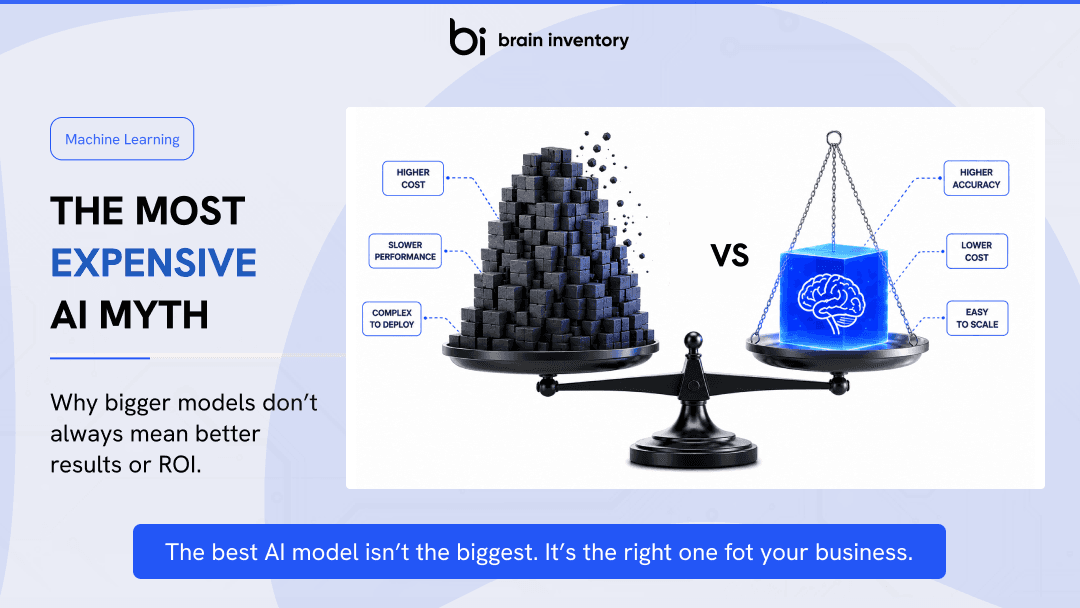
These numbers are often presented as proof that one AI model is inherently better than another. The larger the model, the more impressive it sounds. But this has created an expensive misconception in enterprise AI: bigger does not automatically mean smarter.
The AI industry is increasingly moving beyond model size and focusing on training quality, reasoning, efficiency, specialization, and deployment costs. For businesses, that means choosing an AI model should be based on real-world performance and business requirements, not simply the number of parameters.
Why AI Model Size Doesn’t Tell the Whole Story
Parameters are the values an AI model learns during training. They help a model recognize patterns, understand relationships between words, and generate responses. While having more parameters can increase a model’s capacity, it does not automatically make the model more accurate, reliable, or useful for every task.Consider two software developers. One has read thousands of books, including outdated and poorly written material. The other has studied fewer resources but focused on high-quality documentation, modern engineering practices, and real-world projects.
Most businesses would choose the second developer for a production system.AI models work in a similar way. Their effectiveness depends on training data quality, architecture, optimization, alignment, and how effectively the model learns from its training material.A larger model trained on noisy or inconsistent data may struggle to outperform a smaller model trained on cleaner and more relevant information.
Smaller Models Are Challenging the Bigger-Is-Better Assumption
The assumption that larger models always perform better has been challenged repeatedly. Microsoft’s Phi-3 Mini, for example, demonstrated impressive reasoning and coding capabilities despite having only a fraction of the parameters found in many frontier models.
Similarly, Mistral 7B demonstrated that a smaller model can compete strongly with larger models on several benchmark tasks.These developments reflect an important change in AI research. Developers are no longer focused exclusively on increasing parameter counts. They are improving architectures, training techniques, attention mechanisms, quantization, and data quality.The result is a growing class of compact models that can deliver strong performance while requiring significantly fewer computational resources.
For businesses, the question should therefore change from “Which model is the biggest?” to “Which model performs best for the job we need it to do?”
Training Data Quality Can Matter More Than Training Volume
One of the most important factors influencing AI performance is the quality of the training data.Large language models learn from enormous collections of books, websites, research papers, documentation, and other sources. However, more data does not necessarily mean better data.Outdated information, duplicated content, contradictory sources, and low-quality material can reduce the value of training. This is why AI researchers increasingly focus on data curation and data quality alongside dataset size.
A model trained on carefully selected, diverse, and reliable information can develop stronger capabilities than a larger model trained on significantly more but lower-quality material.The principle is simple: more information does not necessarily create a smarter model; better information can create a more useful one.
Why Specialized AI Can Beat General-Purpose Models
Businesses rarely need an AI system that knows a little about everything. They need an AI system that understands their products, customers, terminology, documentation, and workflows.
A general-purpose model is designed to handle thousands of different use cases. It may need to write marketing content, summarize documents, answer technical questions, explain scientific concepts, and generate software code.That flexibility is valuable, but specialization can deliver better results for specific business applications.
A smaller model adapted for customer support, financial analysis, manufacturing, or software development may outperform a much larger general-purpose model on the tasks that matter most to an organization.
How Fine-Tuning Can Make Smaller Models More Valuable
Fine-tuning allows organizations to adapt a pre-trained model using domain-specific data. Instead of teaching an AI everything from scratch, businesses can help it become better at a particular field or workflow.
For example, a smaller model optimized for financial services can be trained around industry terminology, compliance requirements, documentation, and common financial questions.
The result may be more useful than simply deploying a much larger general-purpose model.The smaller model has not become universally smarter. It has become more relevant to the task.This distinction has major implications for enterprise AI. Relevance, accuracy, speed, and consistency can be more valuable than having access to the largest possible model.
What Actually Makes an AI Feel Intelligent?
Two AI models can provide technically correct answers while delivering completely different user experiences. One may understand vague instructions, ask useful follow-up questions, organize information clearly, and recover well when the conversation changes. The other may struggle despite having more parameters.
This difference often comes down to alignment. Alignment helps AI systems behave in ways that are useful, safe, and consistent with human expectations. Techniques such as Reinforcement Learning from Human Feedback (RLHF) can help models learn which responses people consider useful, accurate, and appropriate.
For businesses, this matters because user experience influences adoption. Employees and customers are more likely to trust an AI system that communicates clearly and consistently than one that simply produces technically correct information.
The Hidden Cost of Chasing Bigger AI Models
Larger models can offer impressive capabilities, but they also introduce significant operational costs.More parameters generally require more memory, processing power, and computational infrastructure. These requirements can increase cloud costs, GPU requirements, energy consumption, and response latency.
At enterprise scale, even a small difference in inference cost can become substantial.Consider an AI-powered customer support assistant handling thousands of conversations every day. If each request costs slightly more to process, the additional expense can become significant over months and years.If two models provide comparable business results but one requires substantially fewer resources, the efficient model may deliver a much better return on investment.
Look Beyond Licensing Costs
AI procurement should not focus only on subscription or API pricing. Businesses should consider the total cost of ownership (TCO). This includes infrastructure, inference, storage, monitoring, security, maintenance, integration, engineering resources, and future scaling requirements.
A model that looks inexpensive initially may become costly if it requires expensive infrastructure or scales inefficiently. A smaller model may reduce operating costs while delivering comparable results for a specific business application. That is why AI cost optimization is becoming an increasingly important part of enterprise AI strategy.
How to Choose the Right AI Model
Once businesses move beyond the assumption that bigger is always better, AI evaluation becomes much more practical.
- Evaluate real-world performance: Test the model against the actual tasks your organization needs to automate.
- Consider customization: Determine whether fine-tuning, retrieval, or other adaptation techniques can improve results.
- Evaluate deployment requirements: Consider cloud, on-premises, private, or edge deployment based on security and regulatory needs.
- Measure scalability: Understand how performance and costs change as usage increases.
- Compare efficiency: Look at latency, infrastructure requirements, and inference costs alongside accuracy.
- Calculate total cost of ownership: Include integration, maintenance, monitoring, security, and engineering costs.
The objective is not to find the model with the highest benchmark score. It is to find the model that provides the best balance of accuracy, efficiency, scalability, flexibility, and cost for a specific business problem.
The AI Industry Is Moving Toward Efficiency
The AI industry is gradually shifting from a race for parameter counts toward a broader focus on efficiency.Advances in Small Language Models (SLMs), quantization, model compression, knowledge distillation, and efficient fine-tuning have shown that useful AI does not always require enormous models.
Smaller specialized models can be faster to deploy, less expensive to operate, and easier to integrate into existing systems. In some applications, they can also provide greater control over data, security, and infrastructure.This does not mean large models are becoming irrelevant. Frontier models remain extremely valuable for complex reasoning and broad general-purpose workloads.
The important lesson is that model size should be treated as one factor among many, not as a universal measure of intelligence.
Final Thoughts
The conversation around AI is moving away from parameter counts and toward practical business outcomes.A larger AI model does not automatically provide better reasoning, greater accuracy, or a superior user experience. Performance depends on training data, architecture, alignment, fine-tuning, specialization, retrieval, and the way the model is deployed.
For businesses, the goal should never be to deploy the biggest AI model available. The goal should be to deploy the model that solves the right problem reliably, efficiently, and economically.The next time an AI vendor leads with parameter count, remember that size is only one characteristic of an AI model, not a guarantee of intelligence.
The smartest AI investment is rarely the largest model. It is the model that provides the right balance of accuracy, efficiency, scalability, and cost for the problem you actually need to solve.
Ready to Build a Smarter AI Strategy?
At Brain Inventory, we help businesses understand where AI can create measurable value and how to choose the right technology for their specific needs. From AI strategy and model selection to custom AI solutions and implementation, our team can help you move beyond the hype and build AI systems designed around real business outcomes.
Want to find the right AI solution for your business? Talk to Brain Inventory today and explore how the right AI model can improve efficiency, reduce costs, and create new opportunities for your organization.