How to Choose the Right AI Model Instead of the Biggest One
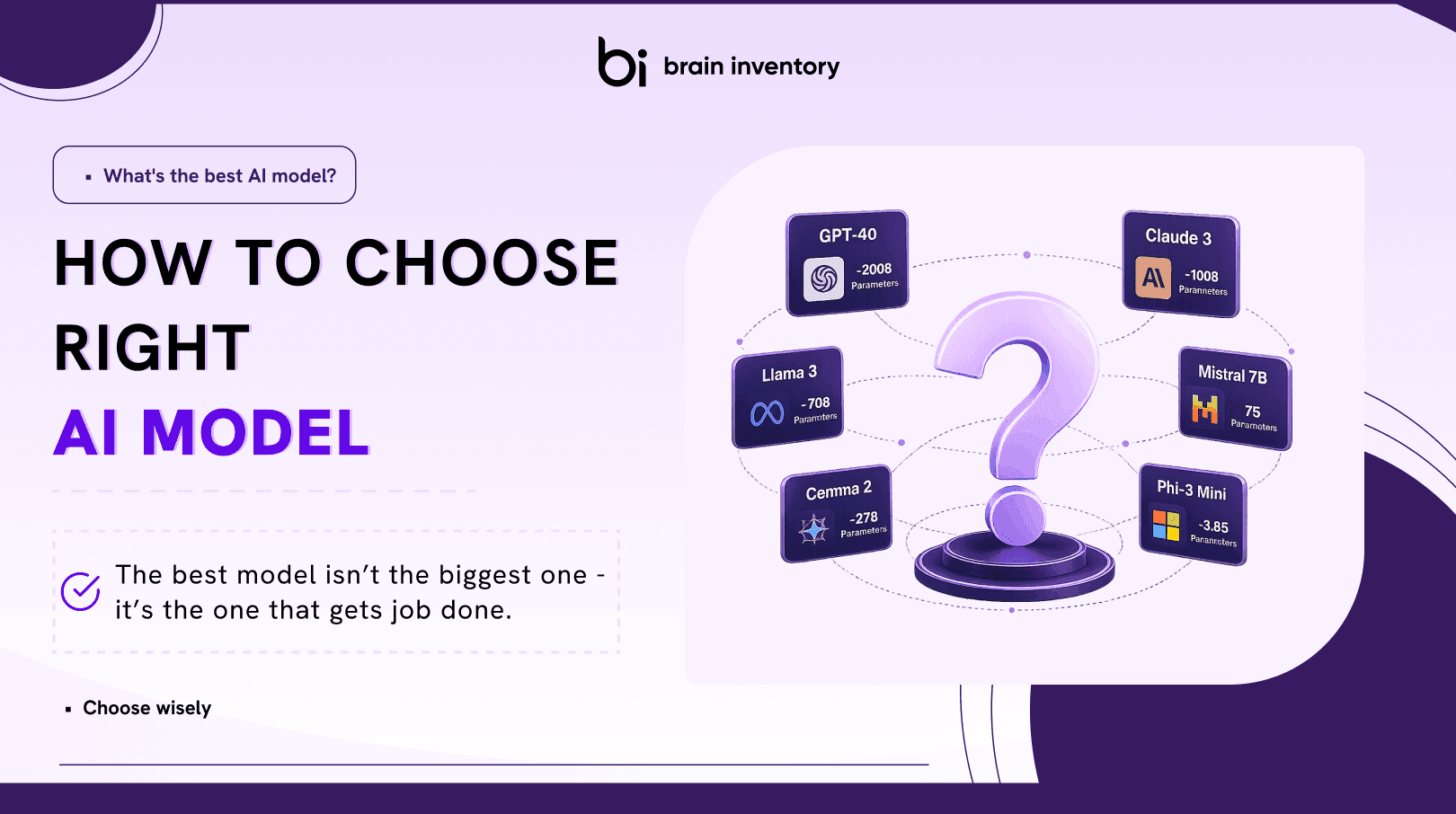
“You should upgrade to the larger model.”It’s probably the most expensive sentence you’ll hear during an AI sales pitch. Vendors often highlight larger parameter counts, bigger context windows, and higher compute requirements as proof that their model is superior. On paper, it sounds convincing. In practice, however, many businesses discover that a lightweight model running on a single GPU can complete the same task faster, at a significantly lower cost, and with comparable accuracy.
This is why AI model selection has evolved beyond finding the most powerful model available. Today, success depends on selecting the model that best fits your workload, infrastructure, and business objectives. The largest AI model isn’t always the most valuable asset in your organization. In many cases, it’s simply the most expensive.
Bigger Models Built the Hype. Smaller Models Are Changing the Story.
For years, parameter count became AI’s equivalent of horsepower. If one Large Language Model (LLM) contained 70 billion parameters while another had only 7 billion, the assumption seemed obvious. Bigger models had to be smarter.
The industry embraced this narrative, vendors used it as a selling point, and businesses planned their AI investments around it. However, recent AI benchmarks have challenged that belief. Smaller, carefully optimized models have demonstrated impressive performance across reasoning, coding, document understanding, and many domain-specific tasks. These results highlight an important reality: AI performance isn’t determined by size alone.
A model doesn’t become more intelligent simply because it contains more parameters. It becomes more useful when it’s trained on high-quality data, aligned with its intended purpose, and optimized for the environment in which it operates. Those factors often contribute far more to real-world performance than raw scale.
Stop Asking, “What’s the Best AI Model?”
A much better question is, “What’s the best AI model for my problem?”
This simple shift in perspective changes how organizations evaluate AI entirely. Consider hiring for your business. If you need an accountant, you wouldn’t hire a neurosurgeon simply because they have more education. They’re undoubtedly highly skilled, but their expertise doesn’t match the job.
AI works in much the same way. A general-purpose model trained on countless topics isn’t automatically better than a specialized model designed for a specific workflow. Whether your business processes invoices, summarizes legal contracts, answers customer queries, or analyzes financial reports, you’re solving a particular problem. Your AI should be optimized for that problem rather than trying to excel at everything.
This is why AI model comparison should begin with your use case, not with benchmark leaderboards.
Bigger Isn’t the Same as Better Trained
Another common misconception is that more training data always creates a better AI model. In reality, data quality often matters far more than data quantity.
Imagine learning a new skill. You could spend weeks reading random internet comments, or you could learn directly from an expert with decades of experience. Most people would choose the expert because high-quality information produces better understanding.
AI models learn in a surprisingly similar way. A model trained on carefully curated, high-quality datasets frequently delivers stronger AI model performance than a much larger model trained on enormous volumes of inconsistent or noisy information. More data can increase knowledge, but better data improves judgment, and those two outcomes aren’t the same.
Fine-Tuning Is Where Good Models Become Great
One aspect that’s often overlooked during AI purchasing decisions is fine-tuning. The most effective AI model for your organization is rarely the one sitting at the top of a public leaderboard. More often, it’s the one that’s been adapted to understand your business, your industry, and your workflows.
Fine-tuned AI models focus on solving specific problems instead of attempting to answer every possible question. A hospital doesn’t need an AI system that knows movie trivia. It needs one that understands patient records and medical documentation. Similarly, an insurance company benefits more from a model that accurately processes claims than one capable of writing poetry.
This explains why many organizations increasingly choose smaller, fine-tuned models instead of massive general-purpose systems. Their decision isn’t driven only by lower operating costs. It’s driven by better performance on the tasks that actually create business value.
The Best AI Model Depends on the Job, Not the Marketing
Many enterprise AI initiatives fail because organizations begin by selecting a model instead of defining the problem they’re trying to solve.
Different applications require different capabilities. A customer support chatbot prioritizes fast responses and reliability. A fraud detection system requires accuracy and pattern recognition. An AI coding assistant benefits from strong reasoning and code generation, while a meeting summarization tool values speed and contextual understanding.
Attempting to solve every business challenge with the largest available model is like using a construction crane to hang a picture frame. The task will certainly get done, but the solution is unnecessarily expensive and inefficient.
Successful organizations don’t ask which AI model has the most parameters. Instead, they ask which model delivers the best outcome for the specific task they’re trying to automate.
A Practical Framework for AI Model Selection
Rather than comparing brand names or benchmark scores first, businesses should evaluate every AI model against a consistent decision-making framework.
The first step is identifying the problem you’re solving. Different workloads require different strengths, whether that’s reasoning, speed, scalability, or low latency. Your business objective should always determine the model you evaluate.
Next, consider how much accuracy your application truly requires. Not every workflow benefits from the most advanced reasoning model. In many situations, a response that’s slightly less accurate but significantly faster and more affordable creates greater business value.
It’s also worth asking whether a smaller model can accomplish the same task. Modern Small Language Models (SLMs) have become remarkably capable across document classification, customer support, workflow automation, and information extraction. These models frequently deliver comparable results while reducing infrastructure costs, improving response times, and simplifying deployment.
Another important decision is whether to use a general-purpose model or a fine-tuned model. Organizations working with legal documents, financial reports, healthcare records, or industry-specific knowledge often achieve better results through fine-tuning.
In many scenarios, combining an AI model with Retrieval-Augmented Generation (RAG) provides an even stronger solution by allowing the model to retrieve current information from organizational knowledge bases instead of relying solely on its training data.
Finally, businesses should evaluate what happens after deployment. Factors such as scalability, security, compliance, infrastructure compatibility, and long-term maintenance are just as important as benchmark scores. A model that integrates smoothly into existing operations often delivers greater value than the highest-ranked model that’s expensive to deploy and maintain.
Conclusion
The AI industry spent years treating parameter count like a scoreboard. Today, organizations are discovering that successful AI adoption depends far less on choosing the largest model and far more on choosing the right one.
Effective AI model selection requires understanding your workload, evaluating real-world AI model performance, balancing deployment costs, and selecting a solution that aligns with your business goals. Sometimes that solution will be a cutting-edge Large Language Model. Other times, it will be a smaller, domain-specific model that quietly outperforms larger competitors where it matters most.
Instead of asking which AI model has the most parameters, businesses should ask which model solves their problem with the least complexity. In AI, just as in business, the smartest choice isn’t always the biggest one. It’s the one that consistently delivers the right results at the right cost.

Have an idea?
Get in touch, we’d be
happy to hear from you
We are always looking out for new collaborations, whether you are a client who is passionate about a project or a talent who is interested in joining our team, our doors are always open.
locate us

India (HQ)
618, Shekhar Central, Palasia Square, A.B Road, Indore, Madhya Pradesh, 452001
+918109561401

United Kingdom
Brain Inventory, SBVS, 8 Roundhay Road, Leeds, UK, LS7 1AB
+18008209286

Canada
44 Main Street East Milton, ONCanada L9T 1N3
+4166696505

Jordan
185 Wasfi Al-Tal Street, Ammon Oasis Complex P.O Box 4724 Amman 11953 Jordan
+960770781000

USA
720 Seneca St Ste 107 Seattle, USA 98101
+1(206)6533419
if it's digital,we'll make it.
- Numetric - Online Accounting Software similar to QuickBooks
- Bloomia - Kegel exercise
- Virifi - Blockchain Powered Document Certification & Signing Platform
- Revolution Travel CRM - Custom CRM Built for Travel Agents
- Fatoura - Online Invoicing Platform
- My Fit Mantra - Your health partner
- Ocureel - Relation Building and video sharing Application




Follow us:


