Edge Computing vs Cloud Computing: Key Differences
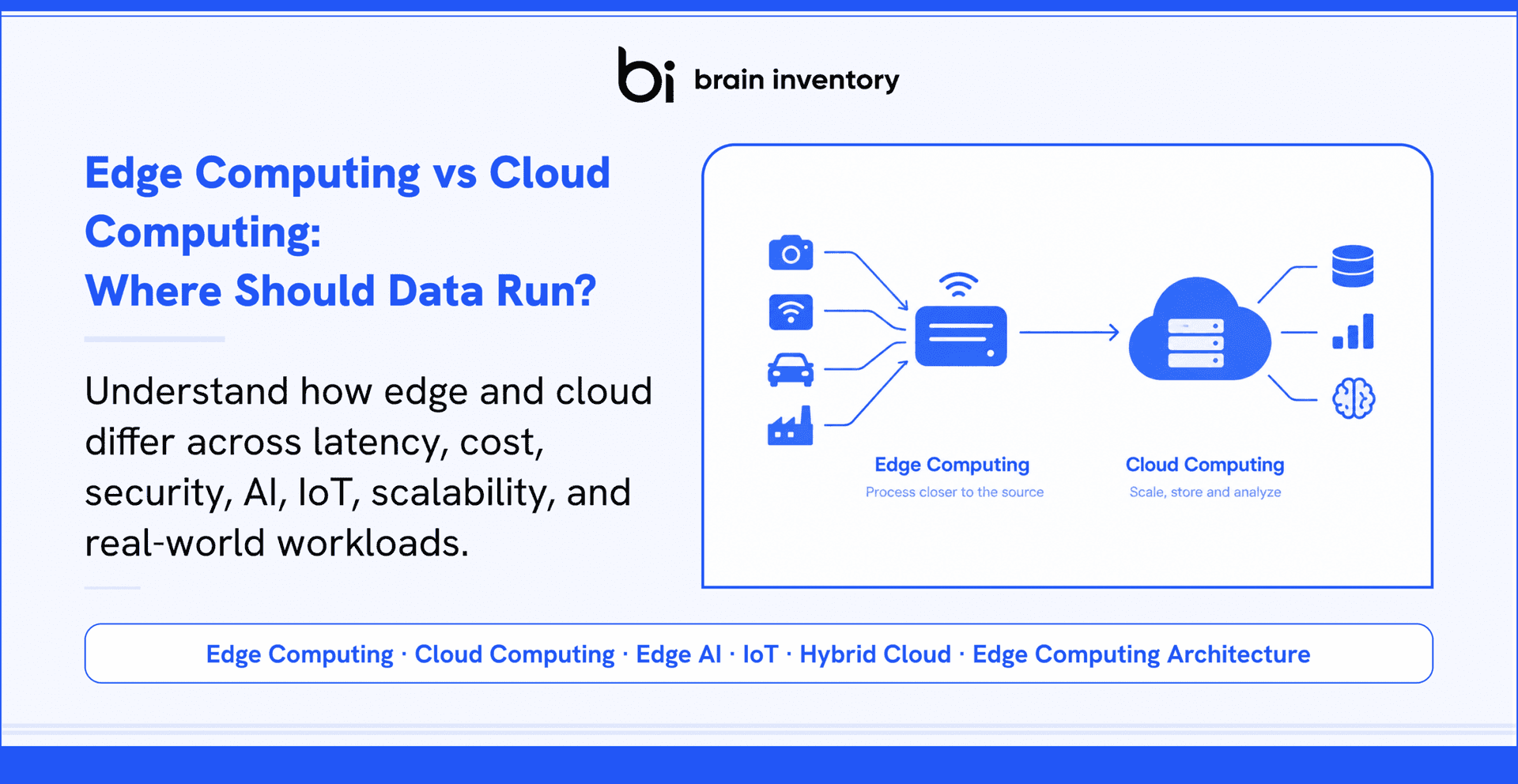
Edge computing vs cloud computing is an important consideration when deciding where an application should process its data. You have a camera, a sensor, an application, or an AI system generating data every second. But once that data starts piling up, there is a more important question than where to store it: where should it be processed?
For years, the obvious answer was the cloud. Cloud computing changed how businesses access infrastructure by making servers, storage, databases, and computing resources available without requiring companies to build and maintain everything themselves. But applications have changed too. Smart factories now have thousands of connected devices. Cars continuously process information from cameras and sensors. AI systems need to respond in real time. Healthcare devices can generate sensitive information that cannot always afford to travel back and forth to a distant data center.
Sending all of that information to the cloud is still useful in many situations, but it is not always the most practical approach.
This is where edge computing comes in. Instead of moving every piece of data to centralized infrastructure, edge computing brings some processing closer to where that data is generated. The difference between edge computing and cloud computing, therefore, is not simply about which technology is faster or more powerful. It is about where computing should happen and why.
What Is Edge Computing and How Does It Work?
Edge computing is a distributed computing approach where data is processed closer to the device, user, or physical location generating it. Instead of sending everything to a centralized cloud environment, an edge device, gateway, or nearby server can handle some of the processing locally.
Consider a manufacturing facility with hundreds of cameras monitoring production lines. Those cameras could continuously send raw video to a remote cloud environment, but that would create a huge amount of network traffic. More importantly, if the system needs to identify a damaged product immediately, waiting for the video to travel to a distant server and return with a response may introduce unnecessary delay.
With edge computing, the video can be processed close to the production line. The system can identify a problem locally and send only the relevant information to the cloud. The cloud can then store the information, analyze historical trends, or use it for broader business intelligence.
The basic flow looks like this:
Device → Edge Infrastructure → Local Processing → Cloud
The cloud is not removed from the picture. Edge computing simply gives certain workloads a place to run closer to the source. This makes it particularly useful for applications that depend on low latency, local decision-making, reduced bandwidth usage, or unreliable network connectivity.
At its core, edge computing focuses on reducing the distance between data generation and data processing. By handling selected workloads locally, businesses can improve response times, reduce unnecessary data transfers, and maintain certain operations even when cloud connectivity is limited.
For a deeper technical explanation, Amazon Web Services explains how edge computing works and why processing data closer to its source can improve application performance and reduce bandwidth requirements.
What Is Cloud Computing?
Cloud computing delivers computing resources through remote infrastructure operated by cloud providers. Instead of maintaining physical servers inside their own facilities, organizations can access computing power, storage, databases, networking, and software services through cloud platforms.
One of the biggest strengths of cloud computing is centralization. An organization can collect information from different locations, store it in one environment, run large-scale analytics, and increase or decrease computing resources according to demand. This makes cloud infrastructure particularly useful for enterprise applications, large databases, data analytics, backups, AI model training, and workloads that require significant computing power.
A typical cloud workflow looks like this:
Device → Internet → Cloud Data Center → Processing → Response
For many applications, this model works extremely well. However, when an application needs an immediate response or operates in a location with unreliable connectivity, sending every request to a centralized cloud environment may not be ideal.
This is one of the main reasons organizations are increasingly looking at edge and cloud as complementary approaches rather than direct replacements for one another.
Businesses exploring centralized infrastructure can also learn more about Brain Inventory’s software development and cloud computing services, including cloud migration, hosting, and storage solutions.
Edge Computing vs Cloud Computing: What Is the Difference?
The easiest way to understand edge computing vs cloud computing is to look at where the processing takes place.
Cloud computing generally moves data toward centralized infrastructure. Edge computing moves at least some of that processing toward the data source. That difference affects latency, bandwidth, scalability, security, storage, connectivity, and the types of workloads each architecture handles well.
Here are the major differences:
- Processing location: Edge computing processes data close to where it is generated, while cloud computing processes data in centralized data centers.
- Latency: Edge computing generally offers lower latency for local workloads because data does not need to travel to a distant server. Cloud latency depends more heavily on network distance and connectivity.
- Bandwidth: Edge computing can reduce bandwidth usage by processing and filtering data locally before sending it to the cloud. Cloud-based systems may need to transfer larger amounts of data to centralized infrastructure.
- Scalability: Cloud computing offers highly scalable centralized resources, while edge computing scales by distributing computing resources across multiple locations and devices.
- Storage: Edge devices usually have more limited storage capacity, while cloud platforms can provide large-scale storage for extensive datasets and historical information.
- Connectivity: Edge systems can continue performing certain local operations even when connectivity to the cloud is interrupted. Cloud applications generally depend more heavily on network connectivity.
- Real-time processing: Edge computing is well suited to applications that need immediate responses, such as industrial automation, autonomous systems, and real-time monitoring. Cloud computing can also support real-time applications, but network latency can become a factor.
- AI workloads: Edge computing is particularly useful for AI inference where decisions need to happen close to the data source. Cloud computing is generally better suited to resource-intensive AI training and large-scale analytics.
- IoT: Edge computing can process IoT data locally and trigger immediate actions, while cloud computing is useful for storing, analyzing, and managing IoT data across multiple devices and locations.
The key takeaway is simple: edge computing brings processing closer to the data, while cloud computing centralizes computing resources at scale. In many real-world systems, both work together rather than operating as alternatives.
Understanding Edge Computing Architecture
One common misconception is that edge computing means putting all processing directly onto a sensor or small device. In reality, an edge computing architecture can contain several layers.
A sensor might generate the initial data. An edge gateway can collect information from several devices and filter it. A nearby edge server can then perform more complex processing before selected information is sent to the cloud.
The architecture can therefore look something like:
Sensors and Devices → Edge Gateway → Edge Server → Cloud
This layered model becomes particularly useful in IoT environments. Imagine a smart factory with thousands of sensors. Sending every raw measurement directly to the cloud would create unnecessary network traffic. Instead, edge infrastructure can identify important events locally and send relevant information to centralized systems.
The cloud can then focus on tasks that benefit from centralization, such as storing historical data, comparing information across multiple locations, training AI models, or generating long-term business insights.
Why Is Edge Computing Faster?
The biggest advantage of edge computing is often its ability to reduce latency.
Imagine an autonomous vehicle detecting an obstacle. The vehicle cannot depend entirely on a distant server to decide what it should do next. Sensor information needs to be processed extremely close to the vehicle so that the system can react without depending on the round trip between the vehicle and a remote data center.
The same principle applies to industrial robots, real-time video analytics, augmented reality, gaming, and other applications where delays can affect the user experience or physical outcome.
A cloud-based system may need to move data across a network before processing it. An edge system can perform at least part of that work locally.
One reason edge computing can improve application performance is that it reduces the need to send every request to a remote data center. This makes edge processing particularly valuable when applications depend on quick decisions and consistent response times.
That does not mean edge computing is automatically faster in every situation. Actual latency depends on network conditions, infrastructure, workload design, and where the edge location is deployed. The advantage comes when placing computation closer to the source removes unnecessary network travel.
Edge Computing vs Cloud Computing for IoT
IoT is one of the clearest examples of why edge computing has become important.
Connected devices can generate enormous amounts of information continuously. A factory might have sensors monitoring temperature, vibration, pressure, machine health, and production quality. A smart city might have cameras and traffic sensors operating across hundreds of locations.
Sending all of that raw information to the cloud is possible, but it is not always efficient.
An edge system can process the information locally, identify unusual behavior, trigger an immediate action, and send only the relevant information to the cloud. The cloud can then maintain historical records and perform broader analysis across different machines, facilities, or locations.
Edge computing for IoT allows connected devices to process information closer to where it is generated. Instead of transferring every sensor reading to centralized infrastructure, businesses can identify important events locally and send only relevant information to the cloud.
This is why edge computing for IoT is often less about replacing the cloud and more about reducing the amount of work the cloud needs to perform.
For a practical example, explore Microsoft’s Azure IoT Edge documentation, which explains how organizations can run cloud workloads locally on edge devices and manage them remotely.
Edge AI vs Cloud AI: Where Should Artificial Intelligence Run?
AI adds another interesting layer to the edge-cloud relationship.
Large AI models can require significant computing resources during training, making centralized cloud infrastructure useful for handling large datasets and intensive workloads. But once a model has been trained, the actual inference process does not always need to happen in the cloud.
Consider a manufacturing company using computer vision to detect defective products. The company could train its model using large datasets in centralized infrastructure. Once trained, the model could be deployed to cameras inside the factory and perform inference locally.
The cloud handles the heavy computational work associated with training and centralized management.
The edge handles the immediate decision.
This is the basic idea behind edge AI. AI models can be placed closer to the devices generating data when response time, connectivity, privacy, or bandwidth makes local inference useful.
This also creates a practical cloud-edge relationship. The cloud can train and update a model, while edge devices can run that model locally and send useful results back to the cloud.
Is Edge Computing More Secure Than Cloud Computing?
This is where the comparison becomes more complicated.
Processing information locally can reduce the amount of sensitive raw data that needs to travel across a network. That can be useful for applications dealing with privacy-sensitive information or data residency requirements.
But that does not automatically make edge computing more secure.
A centralized cloud environment may involve a relatively limited number of infrastructure locations. An edge deployment could involve hundreds or thousands of distributed devices, gateways, and servers. Each additional endpoint introduces another system that needs to be authenticated, monitored, updated, and protected.
Edge security can therefore involve device authentication, encryption, secure software updates, physical protection, endpoint security, identity management, and remote monitoring.
The right question is not simply whether edge or cloud is more secure. It is which architecture allows the organization to meet its security, privacy, and compliance requirements for a particular workload?
Is Edge Computing Cheaper Than Cloud Computing?
Cost is another area where simplistic comparisons can be misleading.
Cloud computing removes much of the need to purchase and maintain physical infrastructure and allows organizations to pay for resources according to usage. Edge computing can reduce bandwidth and cloud processing costs by filtering or analyzing data locally.
However, edge infrastructure comes with its own expenses. Organizations may need to purchase edge hardware, deploy it across multiple locations, maintain it, monitor it, update software remotely, and manage a large number of distributed devices.
Imagine a company processing huge amounts of video. Processing the video locally and sending only important events to the cloud could reduce network and storage costs. But deploying thousands of edge devices could also introduce significant operational expenses.
So the question is not simply “Is edge cheaper than cloud?”
It is:
“Which architecture produces the better total cost for this workload?”
Can Edge Computing and Cloud Computing Work Together?
Absolutely. In fact, this is where the simple “edge vs cloud” debate starts to break down.
Modern infrastructure can combine both approaches into a hybrid edge cloud computing architecture.
The edge can handle workloads that require immediate processing, local decisions, and data filtering. The cloud can handle long-term storage, large-scale analytics, AI training, centralized management, and workloads that benefit from significant computing resources.
Consider the smart factory example again. An edge system could detect a machine abnormality within milliseconds and trigger an alert. At the same time, selected machine data could be sent to the cloud, where it is combined with months of historical information to identify larger production trends.
The edge handles what needs to happen now.
The cloud handles what benefits from centralized scale.
Combining edge computing with cloud infrastructure gives businesses more flexibility when distributing workloads. Applications can process time-sensitive information locally while using centralized cloud resources for storage, analytics, and large-scale computing.
This is why modern infrastructure is increasingly moving toward a combination of edge and cloud rather than treating them as mutually exclusive options.
Organizations planning such systems can also explore Brain Inventory’s software development approach to understand how technology requirements, architecture, and development processes come together during a project.
What Happens When an Edge Device Loses Internet Connectivity?
One overlooked advantage of edge computing is its ability to support local processing when connectivity is unreliable.
An edge system can continue handling certain operations locally instead of waiting for the cloud to become reachable. Depending on the architecture, data can be stored temporarily and synchronized with the cloud once connectivity is restored.
This matters in environments such as remote industrial facilities, connected vehicles, agricultural operations, and locations where network connectivity cannot be guaranteed.
However, edge computing does not mean an application never needs the internet. Many edge systems still depend on cloud connectivity for software updates, centralized analytics, synchronization, monitoring, and long-term storage.
The difference is that critical local operations do not necessarily have to stop every time the connection to the cloud is interrupted.
When Should You Use Edge Computing?
Edge computing is a strong option when an application needs low latency, generates large amounts of local data, operates with unreliable connectivity, requires local decision-making, or has privacy requirements that make constant data transmission undesirable.
Autonomous systems, industrial automation, smart factories, real-time video analysis, healthcare monitoring, and AI inference are examples where edge infrastructure can provide a meaningful advantage.
However, edge is not automatically the right answer. If an application does not require local processing and would benefit more from centralized infrastructure, deploying edge hardware could simply add unnecessary complexity.
When Should You Use Cloud Computing?
Cloud computing remains the stronger choice for workloads that need large-scale storage, centralized management, elastic computing resources, broad data analytics, or significant centralized processing power.
Enterprise applications, data warehouses, backups, large databases, AI model training, and applications serving users across multiple locations can benefit significantly from centralized cloud infrastructure.
Cloud computing also makes sense when latency is not restrictive enough to justify distributing infrastructure closer to the data source.
Edge vs Cloud: Which One Should You Choose?
The answer should not be based on which technology sounds newer.
Instead, start with the workload.
Does the application need an immediate response? Does it generate massive amounts of data locally? Can it tolerate network interruptions? Does sensitive information need to remain near its source? If the answer is yes, edge computing may be the better fit.
Does the application need enormous amounts of storage, centralized analytics, elastic compute, or large-scale AI training? Cloud computing may make more sense.
And if the workload needs both?
Use both.
A camera might identify an event locally. An edge server might make an immediate decision. The cloud might then store the relevant information and analyze months of accumulated data.
That is why edge computing vs cloud computing is not really about picking a winner. It is about placing each workload where it can perform most effectively.
Conclusion
Cloud computing transformed modern infrastructure by making centralized computing power accessible, scalable, and easier to manage. Edge computing is extending that model by moving selected processing closer to the people, devices, and machines generating data.
Neither approach makes the other obsolete.
Cloud computing remains valuable for centralized storage, large-scale analytics, AI training, and resource-intensive workloads. Edge computing becomes valuable when latency, connectivity, bandwidth, privacy, or local decision-making changes the requirements.
For many modern applications, the strongest architecture will not be purely edge or purely cloud. It will combine the two, assigning workloads according to what they actually need.
The real question is no longer “Edge or cloud?”
It is:
“Where should this workload run?”
That question is what makes the difference between edge computing and cloud computing worth understanding.
Building the Right Architecture for Your Business?
Choosing between edge and cloud computing is only one part of designing an effective technology infrastructure. The right architecture also depends on application requirements, data volumes, connectivity, security, scalability, and long-term business goals.
At Brain Inventory, we help businesses turn technical requirements into scalable software solutions. Whether you are exploring cloud-based applications, connected systems, or more complex technology requirements, the right development approach starts with understanding how your product needs to work.
Explore Brain Inventory’s software development solutions and connect with our team to discuss your next project.

Have an idea?
Get in touch, we’d be
happy to hear from you
We are always looking out for new collaborations, whether you are a client who is passionate about a project or a talent who is interested in joining our team, our doors are always open.
locate us

India (HQ)
618, Shekhar Central, Palasia Square, A.B Road, Indore, Madhya Pradesh, 452001
+918109561401

United Kingdom
Brain Inventory, SBVS, 8 Roundhay Road, Leeds, UK, LS7 1AB
+18008209286

Canada
44 Main Street East Milton, ONCanada L9T 1N3
+4166696505

Jordan
185 Wasfi Al-Tal Street, Ammon Oasis Complex P.O Box 4724 Amman 11953 Jordan
+960770781000

USA
720 Seneca St Ste 107 Seattle, USA 98101
+1(206)6533419
if it's digital,we'll make it.
- Numetric - Online Accounting Software similar to QuickBooks
- Bloomia - Kegel exercise
- Virifi - Blockchain Powered Document Certification & Signing Platform
- Revolution Travel CRM - Custom CRM Built for Travel Agents
- Fatoura - Online Invoicing Platform
- My Fit Mantra - Your health partner
- Ocureel - Relation Building and video sharing Application




Follow us:


