WebSockets vs REST API: Key Differences & Use Cases
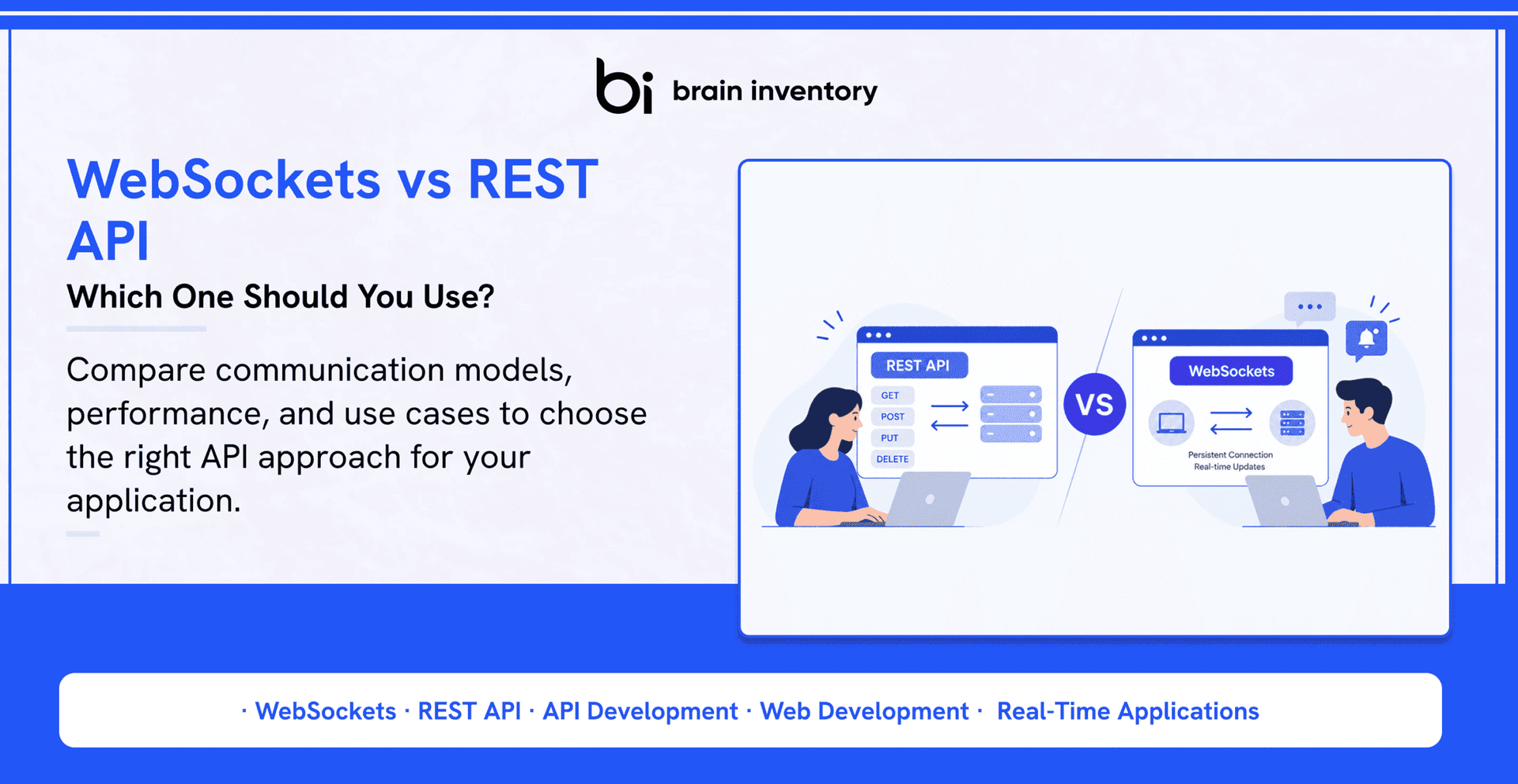
When building a web or mobile application, the way your frontend communicates with your backend can significantly affect performance, scalability, and user experience.
For many applications, REST APIs are the natural starting point. They work well for retrieving data, submitting forms, managing users, processing transactions, and handling other request-based operations.
But what if your application needs information to move continuously and with minimal delay?
That is where WebSockets become useful.
The comparison between WebSockets vs REST API is not about deciding which technology is newer or universally faster. Each one is designed for a different communication pattern. REST works well when the client sends a request and waits for a response, while WebSockets are designed for persistent, two-way communication and live updates.
So, which option should you choose?
The right answer depends on how your application needs to exchange data.
WebSockets vs REST API: What’s the Difference?
REST and WebSockets differ mainly in how communication is initiated and maintained between the client and server.
A REST API typically follows a request-response pattern. The client sends a request, the server processes it, and the server returns a response. Each operation is handled as a separate interaction.
WebSockets use a different approach. They create a persistent connection between the client and server. After the connection is established, both sides can send messages whenever necessary without creating a new request for every update.
The main differences include:
- Communication: REST uses a request-response model, while WebSockets support two-way communication.
- Connection: REST typically handles individual HTTP requests, while WebSockets maintain a persistent connection.
- Server updates: REST usually responds after a client request, while WebSockets allow the server to send data whenever an event occurs.
- Real-time communication: REST can support limited live functionality through additional techniques, while WebSockets are designed for continuous updates.
- State: REST is stateless by design, while WebSockets are associated with an ongoing connection.
- Frequent updates: REST may create more overhead when updates occur often, while WebSockets can exchange messages efficiently after the connection is open.
- Scaling: REST is generally simpler to scale, while WebSockets require careful management of long-lived connections.
- Best use cases: REST is well suited to CRUD operations, transactions, and public APIs. WebSockets are better for chat, live dashboards, collaboration, and other interactive features.
Technically, REST is an architectural style, while WebSocket is a communication protocol. However, comparing them is useful when deciding how different parts of an application should exchange data.
What Is a REST API?
REST stands for Representational State Transfer. It is a set of architectural principles commonly used to build APIs over HTTP.
A REST API exposes resources through endpoints and uses standard HTTP methods such as:
- GET to retrieve data
- POST to create data
- PUT/PATCH to update data
- DELETE to remove data
For example, an e-commerce application might use REST APIs to:
- Retrieve a list of products
- Create a new order
- Update a customer’s profile
- Check an order’s status
- Process a payment
REST APIs are widely used because they are relatively easy to build, understand, test, document, and integrate. Their stateless design also works well with common web infrastructure, caching systems, load balancers, and service-based architectures.
What Are WebSockets?
WebSockets provide a persistent, full-duplex communication channel between a client and a server. The connection begins with an HTTP-based handshake. After the connection is upgraded, it remains open so that both the client and server can send messages independently.
Consider a chat application. With a traditional request-response approach, the client would need to repeatedly ask the server whether a new message is available. With WebSockets, the server can deliver the message as soon as it is received. This makes WebSockets useful for applications where data needs to move continuously or where delays should be kept as low as possible.
Common examples include:
- Live chat
- Multiplayer games
- Real-time dashboards
- Collaborative applications
- Live sports scores
- Financial market updates
- Real-time notifications
- IoT systems
- AI applications with streaming responses
WebSockets vs REST API: How Do They Work?
The difference becomes clearer when you look at the communication flow.
With REST, the client starts each interaction:
Client → Request → Server → Response → Client
If the client needs updated information later, it usually sends another request.
With WebSockets, the connection stays open:
Client ↔ Server
Either side can send messages whenever required.
This makes WebSockets a strong option when the server needs to deliver updates proactively instead of waiting for the client to request them.
WebSockets vs REST API: Key Differences
Communication Model
REST follows a request-response model. The client asks for information or submits an operation, and the server returns a result. WebSockets support full-duplex communication. Once the connection is established, the client and server can exchange messages independently.
This distinction matters most in applications where updates need to appear immediately or where both sides must communicate frequently.
Connection
REST APIs generally process interactions through HTTP requests. Each request represents a separate operation, although the underlying HTTP connection may sometimes be reused through connection-management features.
WebSockets maintain a long-lived connection.
After the connection is established, multiple messages can travel through it without repeating the complete HTTP request process for every update.
State
REST is stateless by design. Each request should include the information the server needs to process it.
WebSockets are connection-oriented. Since the connection remains active, the application can associate information with that specific session.
This can be useful for features such as:
- Chat sessions
- User presence
- Subscriptions
- Collaborative editing
- Live data feeds
However, persistent connections also require additional planning. Applications need to handle disconnections, reconnections, authentication changes, connection timeouts, and session recovery.
Server-Initiated Updates
This is one of the most important practical differences.
With a standard REST request, the server generally sends a response after the client initiates communication.
With WebSockets, the server can send a message whenever a relevant event occurs.
For example, a food delivery application could use REST to retrieve the current order status and WebSockets to deliver live changes such as:
Order confirmed → Restaurant preparing → Out for delivery → Delivered
WebSockets vs REST API: Which One Is Faster?
There is no universal winner. For occasional requests, REST is usually fast enough. If an application only needs to retrieve or update information from time to time, introducing a persistent WebSocket connection may add unnecessary complexity.
For frequent, real-time communication, WebSockets can reduce overhead because the connection is already open. Messages can continue flowing through the existing connection instead of repeatedly starting new request-response interactions. This can make WebSockets a better fit for low-latency applications.
However, WebSockets are not automatically faster for every workload. Their main advantage appears when an application needs frequent updates, continuous communication, or server-initiated messages.
Why REST Polling Isn’t Ideal for Real-Time Updates
Polling is one way to make a REST-based application check for new information.
The client repeatedly asks:
“Is there anything new?”
For example, it might request updated data every few seconds. This approach can work, but it may generate unnecessary requests when nothing has changed. It can also create a delay between an event occurring and the client discovering it.
Imagine a chat application that checks for new messages every five seconds. If a message arrives just after a check, the user may wait several seconds before seeing it. WebSockets avoid this repeated checking. Once the connection is open, the server can send the new message immediately.
REST-based systems can also use alternatives such as Server-Sent Events (SSE) or HTTP streaming when the application only needs a continuous server-to-client data flow.
WebSockets vs REST API for AI Streaming
AI applications make the difference between these communication models especially noticeable. Suppose an AI assistant generates a long response. With a traditional request-response approach, the application may wait until the complete response is ready before displaying it.
Streaming improves the experience by allowing partial output to appear as it is generated. WebSockets are useful when an AI application needs a persistent, interactive connection through which the client and server can exchange information continuously.
For example, an AI application could use WebSockets for:
- Streaming generated responses
- Voice or audio interactions
- Real-time agent updates
- Continuous user sessions
- Live progress updates
- Interactive AI interfaces
WebSockets are not the only option for AI streaming. HTTP streaming and SSE may also be suitable, especially when the primary requirement is sending generated content from the server to the client. The best choice depends on whether the application needs one-way streaming or ongoing communication in both directions.
When Should You Use REST API?
REST is usually the better choice when communication is primarily request-driven.
Use REST when your application needs to:
- Create, read, update, or delete resources
- Process transactions
- Retrieve information occasionally
- Build a public API
- Integrate with third-party services
- Work with cacheable resources
- Communicate between stateless services
- Run in short-lived or serverless environments
For example, an online store could use REST APIs to retrieve products, create orders, update customer details, and process payments. These operations generally do not require a connection to remain open after the response is delivered.
When Should You Use WebSockets?
WebSockets are more appropriate when your application requires continuous, real-time communication.
Consider WebSockets for:
- Chat applications
- Multiplayer games
- Real-time collaboration
- Live dashboards
- Financial data feeds
- Live sports updates
- Real-time notifications
- IoT systems
- Interactive AI applications
A simple rule is:
If the client sends a request and waits for a response, REST is often a good fit.
If the client and server need to communicate continuously, WebSockets are worth considering.
Can You Use REST API and WebSockets Together?
Absolutely. Many applications use both technologies because different features often require different communication patterns. For example, a collaborative project management application could use REST to:
- Create projects
- Fetch tasks
- Update user profiles
- Load historical data
At the same time, it could use WebSockets to:
- Notify users when a task changes
- Show who is currently online
- Push new comments
- Update activity feeds in real time
This approach allows each technology to handle the type of communication it supports best. REST can manage standard API operations, while WebSockets can deliver live events and updates.
WebSockets vs REST API: What About SSE?
WebSockets are not the only option for delivering live updates. Server-Sent Events, or SSE, allow a server to continuously send updates to a client over an HTTP connection. The main difference is the direction of communication.
With SSE:
Server → Client
With WebSockets:
Client ↔ Server
SSE can be useful when an application mainly needs server-to-client streaming, such as live notifications, status changes, progress updates, or certain AI response streams. If the client also needs to send frequent messages through the same persistent connection, WebSockets are generally a better fit.
WebSockets vs REST API: Pros and Cons
REST API Pros
- Simple request-response model
- Stateless architecture
- Easy to understand and implement
- Works well with standard HTTP infrastructure
- Supports caching effectively
- Well suited for CRUD operations
- Generally straightforward to scale
REST API Cons
- Not primarily designed for continuous real-time communication
- Polling can generate unnecessary requests
- Frequent updates may create additional overhead
- Server-initiated updates require extra mechanisms
WebSocket Pros
- Persistent connection
- Full-duplex communication
- Low latency for frequent updates
- Allows the server to push information immediately
- Well suited for real-time applications
- Efficient for continuous data exchange
WebSocket Cons
- More complex connection management
- Requires reliable disconnection and reconnection handling
- Scaling persistent connections may require additional infrastructure
- Debugging can be more involved than debugging standard HTTP requests
- Unnecessary for simple request-response applications
WebSockets vs REST API: Which One Should You Choose?
The decision between WebSockets and REST API should begin with one question:
Does your application need continuous, real-time communication?
If the answer is no, REST is usually the simpler and more practical choice.
If the answer is yes, WebSockets may be the better option.
However, many real-world applications do not need to choose only one.
They use REST and WebSockets together.
Use REST for standard request-response operations, resource management, transactions, and data retrieval. Use WebSockets for live updates, continuous communication, presence indicators, and low-latency interactions.
The goal is not to choose the technology that sounds more advanced. The goal is to select the communication model that matches the application’s requirements.
Frequently Asked Questions
Is WebSocket better than REST API?
Neither is universally better. REST is better suited to request-driven operations such as CRUD, transactions, and public APIs. WebSockets are better suited to real-time, two-way communication such as chat, live collaboration, and interactive streaming.
Is WebSocket faster than REST API?
WebSockets can provide lower latency for frequent communication because they maintain an open connection and avoid repeating the full request-response process. REST is often the better choice for occasional requests because it is simpler and usually provides sufficient performance.
Can REST API and WebSockets be used together?
Yes. An application can use REST for standard API operations and WebSockets for real-time updates. This combined approach allows each technology to handle the communication pattern it is best suited for.
When should I use WebSockets?
Use WebSockets when your application needs frequent, real-time, two-way communication. Common examples include chat, multiplayer gaming, live dashboards, collaborative applications, financial feeds, IoT systems, and interactive AI tools.
Can REST APIs be used for AI streaming?
Yes. HTTP streaming and SSE can deliver partial AI responses as they become available. WebSockets are another option, especially when the application needs persistent, bidirectional communication rather than only server-to-client streaming.
What is the main difference between REST and WebSockets?
REST generally uses a request-response model in which the client initiates communication. WebSockets maintain a persistent connection that allows both the client and server to send messages independently.
Final Thoughts
REST and WebSockets are not competing technologies that require an all-or-nothing decision.
REST remains a strong choice for conventional API operations, CRUD functionality, transactions, and request-driven communication. WebSockets are valuable when an application needs persistent, real-time, bidirectional communication.
The simplest way to remember the difference is:
REST: “I need this data.”
WebSocket: “Keep me connected and tell me when something changes.”
Choose based on your application’s communication requirements rather than simply selecting the technology that appears faster or more modern.
If you need to build a real-time application, integrate WebSockets with your REST API, or create a solution with live updates and AI streaming, contact Brain Inventory. Our team can help you choose the right architecture and develop a reliable, scalable solution for your business.

Have an idea?
Get in touch, we’d be
happy to hear from you
We are always looking out for new collaborations, whether you are a client who is passionate about a project or a talent who is interested in joining our team, our doors are always open.
locate us

India (HQ)
618, Shekhar Central, Palasia Square, A.B Road, Indore, Madhya Pradesh, 452001
+918109561401

United Kingdom
Brain Inventory, SBVS, 8 Roundhay Road, Leeds, UK, LS7 1AB
+18008209286

Canada
44 Main Street East Milton, ONCanada L9T 1N3
+4166696505

Jordan
185 Wasfi Al-Tal Street, Ammon Oasis Complex P.O Box 4724 Amman 11953 Jordan
+960770781000

USA
720 Seneca St Ste 107 Seattle, USA 98101
+1(206)6533419
if it's digital,we'll make it.
- Numetric - Online Accounting Software similar to QuickBooks
- Bloomia - Kegel exercise
- Virifi - Blockchain Powered Document Certification & Signing Platform
- Revolution Travel CRM - Custom CRM Built for Travel Agents
- Fatoura - Online Invoicing Platform
- My Fit Mantra - Your health partner
- Ocureel - Relation Building and video sharing Application




Follow us:


