Why Database Design Matters More Than Frameworks
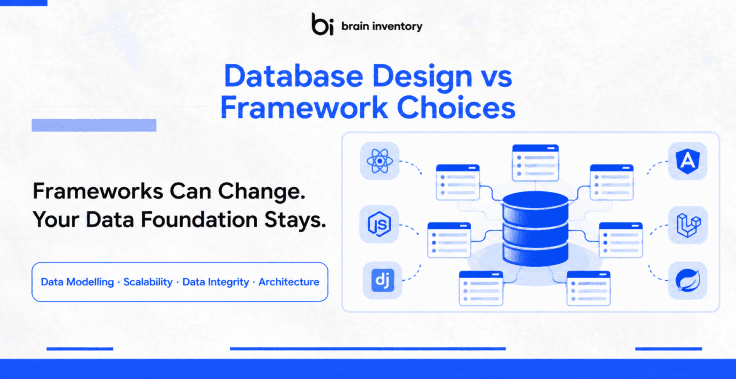
When a software project begins, one of the first conversations is often about the technology stack. Should the application use React or Angular? Node.js or another backend framework? Django, Laravel, Spring Boot, or something else? These choices matter, but they are rarely the decisions that determine whether a product remains healthy as it grows.
A framework influences how an application is built. Database design influences how the application stores, retrieves, connects, and makes sense of its most valuable information. That difference becomes increasingly important as the product gains users, accumulates data, and develops more complex business requirements.
A framework can often be replaced, upgraded, or gradually introduced without changing the underlying business data. A poorly designed database is different. Once thousands or millions of records, business rules, integrations, reports, APIs, and application features depend on a particular data structure, changing it can become a major engineering project.
Frameworks Can Change. Data Usually Stays.
Technology choices evolve quickly. A team might start with one backend framework and later migrate to another because of changing requirements, developer availability, performance considerations, or architectural decisions. Frontend frameworks can also change as products mature. These migrations can be difficult, but they are generally possible because the application’s underlying data can remain intact while the software around it changes. The database sits much closer to the business itself.
Customers, orders, payments, products, subscriptions, employees, permissions, transactions, and other core entities are not simply technical implementation details. They represent how the business operates. If those relationships are modelled poorly, every layer built above them inherits the problem. Consider an e-commerce application. The framework might determine how an order endpoint is implemented. The database determines how customers, orders, products, payments, addresses, discounts, inventory, and order items relate to one another.
If those relationships are unclear or duplicated, adding something as ordinary as partial refunds, multiple shipping addresses, or product variations can become unnecessarily complicated. The framework may change over the lifetime of the application. The business data usually cannot simply be thrown away and rebuilt.
Poor Database Design Creates Problems That Spread
Database problems rarely remain isolated to the database. A weak schema can force developers to write complicated queries. Those queries can make APIs harder to maintain. Slow queries can increase application response times. Developers may then introduce caching to compensate. Eventually, cached data can become inconsistent, creating another layer of complexity. This is how a database decision made early in development can turn into an application-wide problem.
For example, storing information that should exist in separate related entities inside one oversized table may initially feel convenient. The application can fetch everything from one place, and development may appear faster. But as the dataset grows, duplicated information becomes harder to maintain. Updating one piece of information may require changing it across many records. Queries become more complicated, indexes become harder to optimize, and reporting can become unreliable.
The opposite problem can happen too. Over-engineering a database into an excessive number of tables and relationships can make straightforward operations unnecessarily difficult. Good database design is therefore not about creating the maximum number of tables or following a theoretical model without considering the product. It is about finding a structure that accurately represents the business while supporting the way the application needs to use its data.
Performance Problems Often Start With Data Modelling
When an application becomes slow, teams frequently look first at the framework, server, API layer, or cloud infrastructure. Sometimes those are the actual causes. But database design is one of the areas that can quietly determine how efficiently an application performs.
Imagine a product that starts with a few thousand users. A query that retrieves customer information may return quickly enough during development. As the product grows to millions of records, the same query can become significantly more expensive if the underlying tables, relationships, indexes, and access patterns were not designed with growth in mind. The issue is not necessarily that the database technology is incapable of handling the workload. The problem may be that the application is asking the database to do unnecessary work.
Indexes, relationships, query patterns, constraints, partitioning strategies, and data types all influence how efficiently information can be accessed. Good design considers these factors before performance becomes an emergency. This is also why simply switching frameworks does not necessarily solve database-related performance problems. A different application framework still has to interact with the same data.
Database Design Determines How Easily a Product Can Evolve
Software rarely remains exactly what was originally planned. A product that begins with basic subscriptions may later need annual plans, discounts, trials, upgrades, downgrades, refunds, regional pricing, tax rules, or enterprise billing. A marketplace may start with a simple seller-buyer relationship and eventually introduce multiple sellers, commissions, returns, logistics, and disputes. New requirements often expose weaknesses in the original data model.
A flexible database structure does not mean predicting every future feature. That is impossible. It means designing relationships and business entities clearly enough that reasonable changes do not require rebuilding the entire foundation. This is one of the biggest differences between software that merely works and software that can continue evolving.
Data Integrity Is More Important Than Developer Convenience
During early development, teams naturally want to move quickly. A developer may be tempted to keep related information together because it makes an immediate feature easier to implement. But short-term convenience can create long-term inconsistencies.
Suppose an application stores customer information in several unrelated places. One part of the system may contain an old phone number while another contains the updated version. Which one is correct? If there is no clear source of truth, every feature consuming that information has to make assumptions. Database constraints and carefully designed relationships can prevent entire categories of problems before they reach the application layer.
Uniqueness constraints can prevent duplicate records. Foreign keys can protect relationships between entities. Appropriate data types can prevent invalid values. Transaction design can help ensure that related changes happen together. These mechanisms are not merely database-level technicalities. They protect the integrity of the product’s business data.
The Right Framework Cannot Fix the Wrong Data Model
Modern development frameworks provide powerful tools for building applications. They can improve developer productivity, simplify API development, support authentication, handle routing, structure application code, and accelerate delivery. But a framework cannot compensate for a fundamentally flawed data model.
A fast backend framework connected to poorly structured data can still produce slow and unreliable software. A sophisticated frontend cannot fix inconsistent records. A modern cloud deployment cannot automatically correct inefficient queries.
This is why architecture discussions should not begin and end with the technology stack. The more useful question is not simply, “Which framework should we use?” It is, “What does the product need to store, how are those entities related, how will that information be accessed, and how might those requirements change as the product grows?” The framework should support those decisions rather than distract from them.
Good Database Design Also Makes Development Easier
Database design is sometimes treated as work that happens before “real development” begins. In reality, a clear data model can make development itself considerably easier.
When developers understand the entities, relationships, ownership rules, and constraints within a system, they have a clearer foundation for building APIs and business logic. New developers can understand the product faster. Reporting becomes easier to reason about. Integrations have clearer sources of data. A well-designed schema can also reduce the amount of business logic developers have to repeatedly implement in application code.
Instead of every part of the application having to remember that a particular record must be unique or that two entities must always remain connected, appropriate database constraints can enforce those rules closer to the data itself. That creates a stronger boundary around the information the application depends on.
Database Design Should Reflect Real Business Processes
One of the most useful ways to approach database design is to stop thinking about tables first and understand the business first. What are the important entities? What information belongs to each entity? Which entities can have multiple relationships? What events change the state of a record? Which information needs to remain historically accurate?
It is also important to understand which records can be deleted, which need to be retained, and what information the application needs to query frequently. These questions create a bridge between business requirements and technical architecture.
For example, a healthcare platform, a fintech application, an e-commerce marketplace, and a project management tool may all use databases, but their data relationships and consistency requirements are completely different. There is no universally perfect schema. The right design depends on what the software actually needs to accomplish.
The Cost of Changing a Database Grows With the Product
Changing a database is not inherently bad. Mature software products regularly evolve their schemas. The challenge is that database changes become more complicated when many parts of the system depend on the existing structure. A schema change may affect application code, APIs, background jobs, reporting systems, integrations, analytics pipelines, dashboards, and historical data. A seemingly simple column change can become a coordinated migration if multiple systems depend on it.
This does not mean teams should try to design a database perfectly before writing any code. It means important data decisions deserve more thought than a framework preference based on popularity or familiarity. The goal is not to predict the future perfectly. The goal is to avoid creating unnecessary constraints that make the future harder.
Framework Choice Still Matters, Just Differently
None of this means framework selection is irrelevant. The framework needs to fit the team’s skills, application requirements, ecosystem, performance needs, development practices, and long-term maintenance expectations. Choosing an unsuitable framework can create its own problems. The difference is in the level of impact.
A framework is one layer of the application architecture. The database often sits underneath many of those layers. If the framework changes, the business data can potentially remain untouched. If the data model is fundamentally wrong, every layer interacting with that data may eventually feel the consequences. That makes database design less visible but often more foundational.
Build the Foundation Before Optimizing the Stack
Software development can make technology choices feel more important than they sometimes are. Developers can compare frameworks, languages, libraries, tools, and platforms for hours because these decisions are visible and easy to discuss. Database design requires a different kind of thinking. It requires understanding the business, modelling relationships, anticipating access patterns, defining constraints, and thinking about how the product may evolve.
That work may not be as exciting as choosing a new framework, but it can have a much longer impact on the software. A framework helps you build the application. A well-designed database helps the application remain reliable as it grows.
That is why database design should not be treated as a supporting technical decision made after the technology stack is chosen. It is part of the foundation on which the product is built. When the underlying data model is clear, consistent, and designed around real business requirements, frameworks have a stronger foundation to work with, and teams have more room to build, change, and scale the product without constantly fighting the architecture.
Final Thoughts: Build for What Comes Next
Choosing a framework is an important part of software development, but building a product that can grow requires looking beyond the technology stack. Database design shapes how information is stored, how different parts of an application communicate, and how easily the product can adapt to changing business requirements.
A framework might influence the development experience today, but the decisions made around data modelling, relationships, integrity, and scalability can affect the product for years. Getting these fundamentals right early can save development time, reduce technical complications, and create a more reliable foundation for future growth.
Ultimately, good software architecture is not just about choosing the right tools. It is about understanding what you are building and creating a foundation that can support where the product needs to go.
Building Software That Is Ready to Scale?
At Brain Inventory, we believe reliable software starts with thoughtful engineering decisions. From database architecture and backend development to building scalable software solutions, our focus is on creating applications that work efficiently today and remain adaptable as businesses grow.
If you are planning a new software product, improving an existing application, or rethinking your technical architecture, let’s talk about building a foundation that supports your next stage of growth.
Connect with Brain Inventory and let’s build software that is designed for the long run.

Have an idea?
Get in touch, we’d be
happy to hear from you
We are always looking out for new collaborations, whether you are a client who is passionate about a project or a talent who is interested in joining our team, our doors are always open.
locate us

India (HQ)
618, Shekhar Central, Palasia Square, A.B Road, Indore, Madhya Pradesh, 452001
+918109561401

United Kingdom
Brain Inventory, SBVS, 8 Roundhay Road, Leeds, UK, LS7 1AB
+18008209286

Canada
44 Main Street East Milton, ONCanada L9T 1N3
+4166696505

Jordan
185 Wasfi Al-Tal Street, Ammon Oasis Complex P.O Box 4724 Amman 11953 Jordan
+960770781000

USA
720 Seneca St Ste 107 Seattle, USA 98101
+1(206)6533419
if it's digital,we'll make it.
- Numetric - Online Accounting Software similar to QuickBooks
- Bloomia - Kegel exercise
- Virifi - Blockchain Powered Document Certification & Signing Platform
- Revolution Travel CRM - Custom CRM Built for Travel Agents
- Fatoura - Online Invoicing Platform
- My Fit Mantra - Your health partner
- Ocureel - Relation Building and video sharing Application




Follow us:


