Database Design vs Framework Choice: What Matters More?
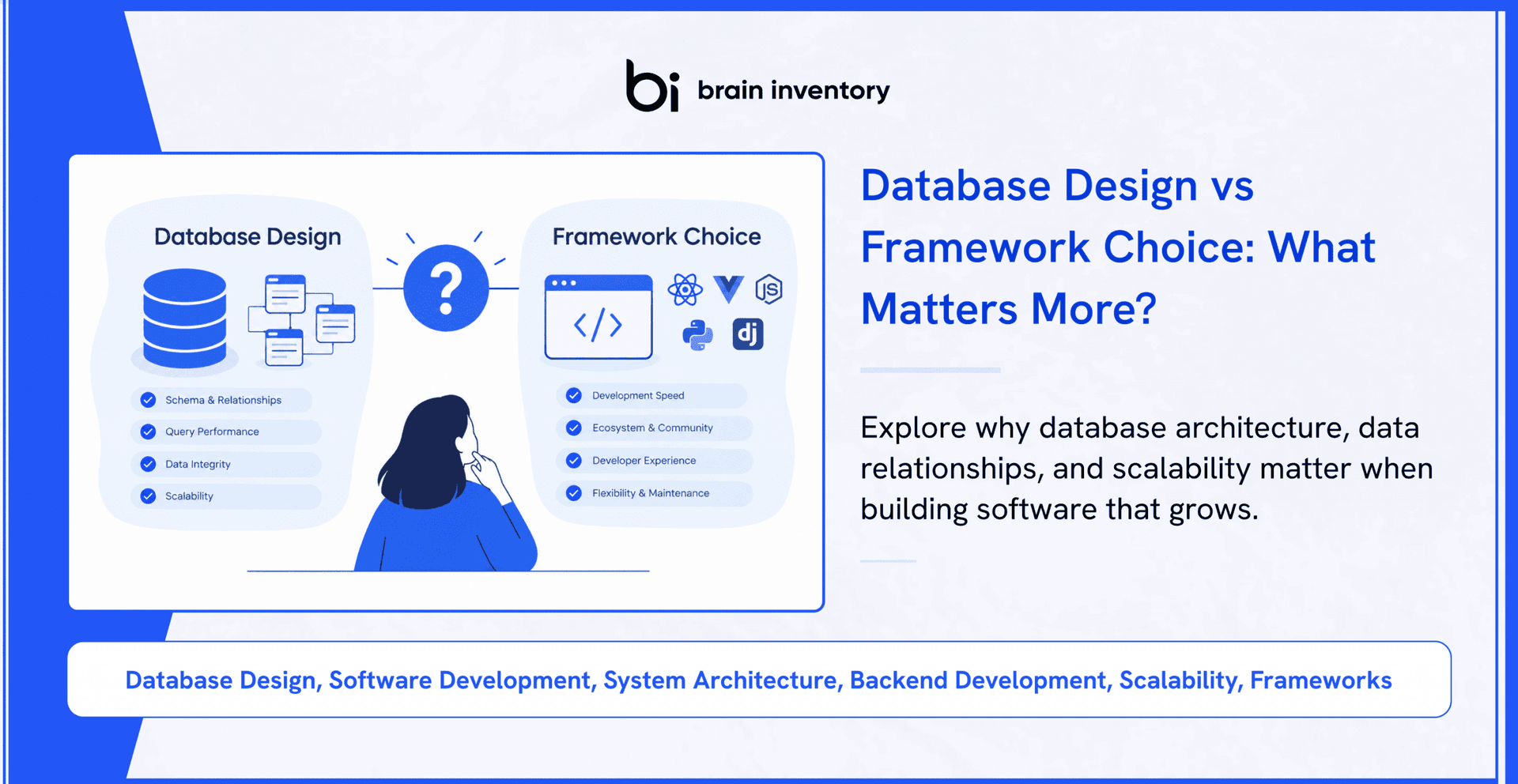
When a new software project begins, framework selection often becomes one of the first technical conversations.
Should the team use React or Vue? Node.js or another backend stack? NestJS or Express? Django or FastAPI?
These decisions are important, but they can sometimes receive more attention than the part of the application that will hold its most valuable asset: the data.
That raises an interesting question for developers and architects: does database design matter more than framework choice?
There is no universal answer, but database architecture can have a much deeper impact on how an application behaves as it grows. A framework can often be replaced or upgraded without changing the underlying data model. A database structure, once deeply connected to business logic and production data, can be considerably harder to rethink.
That does not make framework selection unimportant. It means the two decisions should not be treated as equally interchangeable.
What Does Database Design Actually Involve?
Database design is more than deciding whether an application should use MySQL, PostgreSQL, MongoDB, or another database. It starts with understanding what the application needs to store and how that information will be used.
Developers need to think about entities, relationships, constraints, data types, queries, indexes, transactions, read and write patterns, and how the structure may evolve over time. Consider an e-commerce application.
Products, customers, orders, payments, inventory, discounts, shipments, and reviews all have different relationships and usage patterns. An order may need to connect with a customer, multiple products, payment information, and shipment details. How those relationships are represented can affect everything from queries to reporting and transaction handling.
This is why database design is fundamentally an application architecture decision, not simply a task for later in development.
Why Framework Choice Gets More Attention
Frameworks are easier to see. Developers interact with them every day. They influence the way APIs are created, components are structured, authentication is handled, requests are processed, and applications are tested.
There is also a huge amount of discussion around frameworks. New releases, benchmarks, comparisons, tutorials, and developer preferences make framework selection feel like a major architectural milestone.
And in many cases, it is. The right framework can improve development speed, provide useful conventions, reduce repetitive work, and give a team access to a mature ecosystem.
But there is a difference between a decision being important and a decision being difficult to reverse. That distinction becomes particularly relevant when comparing frameworks with database design.
Database Design Can Create Long-Term Constraints
Imagine a team chooses a backend framework and later realizes that another framework would be a better fit. The migration may require rewriting routes, services, middleware, integrations, tests, and application logic. It can be expensive, but the team may still be able to preserve the underlying database and its historical records.
Now imagine that the database structure itself is fundamentally wrong. The application has been running for three years. There are millions of records. Several services depend on existing tables or collections. Reports rely on established queries. APIs expose certain data relationships. Background jobs expect specific structures.
Changing the database now is no longer simply a development task. It can involve data migration, compatibility layers, query changes, testing, validation, rollback planning, and careful coordination across production systems.
This is one reason database architecture deserves serious consideration before an application becomes heavily dependent on it.
The Database Should Be Designed Around the Application
One of the easiest mistakes is choosing technology before understanding the problem. For example, a team may already be comfortable with a particular database and decide to use it for every new application. Another team might select a database because it is popular in its preferred technology stack. Neither approach necessarily answers the important question:
What does this application need from its data layer?
Start with the application instead.
What information needs to be stored?
How are different pieces of information related?
Which operations will happen most frequently?
Will the application perform complex transactions?
Is the workload primarily read-heavy or write-heavy?
Does the data have a predictable structure?
Will the application need advanced search, analytics, real-time processing, or highly flexible records?
These questions help shape the database architecture before a specific technology is selected.
Performance Starts With Data Decisions
Database performance is often treated as something developers fix after the application becomes slow. By that point, some architectural decisions may already be difficult to change.
The structure of the data affects how efficiently the application can retrieve and modify information. Poorly planned relationships can result in unnecessarily complex queries. Missing or inappropriate indexes can increase query times. An inefficient schema can make common operations more expensive as data volume increases.
Performance also depends on actual usage patterns. An application that performs well with 10,000 records may behave differently once it has millions of records and significantly more concurrent requests.
This is why database performance should not be reduced to choosing a database with impressive benchmark numbers. The way the application stores and accesses data matters just as much.
Framework Choice Still Matters
The argument for prioritising database design should not turn into an argument against careful framework selection. Framework choice can have a major impact on the development experience and the application itself.
A framework can influence:
- Development speed
- Code organisation
- Testing practices
- Security implementation
- API development
- Team onboarding
- Third-party integrations
- Maintainability
- Available libraries and tooling
A framework that matches the team’s technical capabilities can make development considerably easier. On the other hand, choosing a framework simply because it is trending or because another project uses it can create unnecessary problems. The best framework is the one that fits the application’s requirements, team expertise, expected workload, and long-term maintenance needs.
What Happens When Framework Choice Comes First?
There is nothing inherently wrong with selecting a framework early. The problem starts when the framework dictates every other architectural decision. For example, developers might begin with a particular technology stack and then choose the database because it is commonly paired with that stack.
This can turn the technology stack into the requirement rather than the solution. A better sequence is to understand the product requirements first, identify the application’s data requirements, define important access patterns, establish the broader architecture, and then select technologies that support those decisions.
This does not mean developers need to spend months designing an architecture before writing code. It means important technical decisions should have a reason behind them.
Don’t Overengineer the Database Either
There is another mistake on the opposite end of the spectrum: designing for a scale that does not exist yet. A startup with a small user base does not necessarily need a highly distributed database architecture from day one.
Introducing unnecessary complexity can increase infrastructure costs, operational overhead, monitoring requirements, and the number of things developers need to understand. Good database design is not about predicting every possible future problem. It is about creating a structure that works for current requirements while leaving reasonable room for change. As the product grows, actual performance data and usage patterns should guide the next architectural decision.
So, Which Matters More: Database Design or Framework Choice?
If the question is about which one deserves more attention during the early architectural stage, database design often deserves greater consideration than it receives. Frameworks influence how developers build the application. Database design influences how the application manages its data over its entire lifecycle.
That does not mean a database decision is always more important. A highly specialised application may have framework requirements that are just as critical. A real-time application, for example, may need a framework and runtime capable of handling its communication model effectively. A team building a complex enterprise application may also benefit significantly from a framework with strong architectural conventions.
The point is not to declare one technology universally superior. The point is to understand which decisions are expensive to reverse.
A Better Way to Approach Both Decisions
Instead of asking, “Which framework should we use?” at the beginning of a project, teams can work through a broader set of questions.
First, understand the product.
What does the application need to accomplish?
Then understand the data.
What information will it store, how is that information related, and how will users access it?
Next, understand the workload.
What operations will happen frequently, and what performance expectations exist?
Then consider scalability.
How might data volume, traffic, and user activity change as the product grows?
Finally, choose the technologies.
Select the database, framework, infrastructure, and supporting tools based on those requirements.
This approach makes framework selection part of the architecture rather than the foundation of the architecture.
Final Thoughts
Frameworks will continue to evolve. New tools will appear, existing frameworks will change, and development teams will adopt different technologies as projects mature. The data layer has a different kind of permanence.
Once an application accumulates years of business data and multiple systems begin depending on its structure, changing the underlying database architecture can become a significant engineering exercise. That is why database design should not be treated as something developers figure out after choosing the framework.
The better approach is to understand the data, workload, application requirements, and expected growth first. Then choose a database architecture and framework that support those decisions.
The best framework can help you build an application faster. The right database design can help ensure that application remains workable as it grows.
Building an Application That Can Grow With Your Business?
Choosing the right framework is only one part of building a reliable software product. The way your database is designed, how your application handles data, and how well the architecture supports future growth all play an important role.
At Brain Inventory, we help businesses build software solutions with the right technical foundation. From database architecture and backend development to scalable application development, our team focuses on building products that are easier to maintain and ready to evolve with your business.
Planning your next software project? Connect with Brain Inventory and let’s build something that works for the long run.

Have an idea?
Get in touch, we’d be
happy to hear from you
We are always looking out for new collaborations, whether you are a client who is passionate about a project or a talent who is interested in joining our team, our doors are always open.
locate us

India (HQ)
618, Shekhar Central, Palasia Square, A.B Road, Indore, Madhya Pradesh, 452001
+918109561401

United Kingdom
Brain Inventory, SBVS, 8 Roundhay Road, Leeds, UK, LS7 1AB
+18008209286

Canada
44 Main Street East Milton, ONCanada L9T 1N3
+4166696505

Jordan
185 Wasfi Al-Tal Street, Ammon Oasis Complex P.O Box 4724 Amman 11953 Jordan
+960770781000

USA
720 Seneca St Ste 107 Seattle, USA 98101
+1(206)6533419
if it's digital,we'll make it.
- Numetric - Online Accounting Software similar to QuickBooks
- Bloomia - Kegel exercise
- Virifi - Blockchain Powered Document Certification & Signing Platform
- Revolution Travel CRM - Custom CRM Built for Travel Agents
- Fatoura - Online Invoicing Platform
- My Fit Mantra - Your health partner
- Ocureel - Relation Building and video sharing Application




Follow us:


