Event Driven Architecture: How It Works
Think about the last time you booked an Uber ride, purchased something on Amazon, or pressed play on Netflix. These actions feel almost instant. You tap a button, wait a few seconds, and the application responds. Behind that simple interaction, however, several systems may start working at once.
When you book a ride, the platform notifies nearby drivers, calculates your fare, maps the route, starts payment authorization, estimates your arrival time, and checks for potential fraud. Analytics tools also record useful information. These processes can begin within seconds, without waiting for one another to finish.
Netflix follows a similar pattern when you start a movie. It updates your viewing history, adjusts streaming quality, records engagement, and uses viewing activity to improve recommendations. After you place an Amazon order, different services handle payment, inventory, warehouse operations, shipping, notifications, and reporting.
If one service had to call every other service in a long sequence, the system would quickly become fragile. A slow or unavailable service could delay the entire workflow. Modern applications avoid this bottleneck by letting systems react to events instead of relying on direct, sequential calls.
This approach is called Event Driven Architecture (EDA). It helps independent services respond to the same activity without building complex dependencies. It also helps large platforms scale while teams add and change features. Understanding EDA offers a useful look at how modern applications coordinate work behind the scenes.
What Is Event Driven Architecture?
Event Driven Architecture is a software design approach in which applications communicate by publishing and responding to events. An event records something important that has happened. It does not tell other systems exactly what to do. Instead, it announces a business activity and lets each interested service decide how to respond.
Examples include a customer placing an order, a payment completing, a user signing in, a ride being booked, or an IoT sensor detecting movement. Each event signals a meaningful change that other parts of the system may need to know about.
A simple real-world analogy
Think about a cricket match. When a batter scores a century, the scoreboard updates, commentators discuss the innings, broadcasters display graphics, and statisticians record the milestone. Fans may celebrate on social media, too. The batter does not contact each group individually. One event happens, and everyone interested in it reacts independently.
Event Driven Architecture works in much the same way. Instead of connecting every service directly to every other service, an application announces an event. Services that subscribe to that event can then handle their own tasks. This loose coupling makes applications easier to scale, maintain, and update because one service can often change without forcing changes across the system.
The Core Building Blocks of Event Driven Architecture
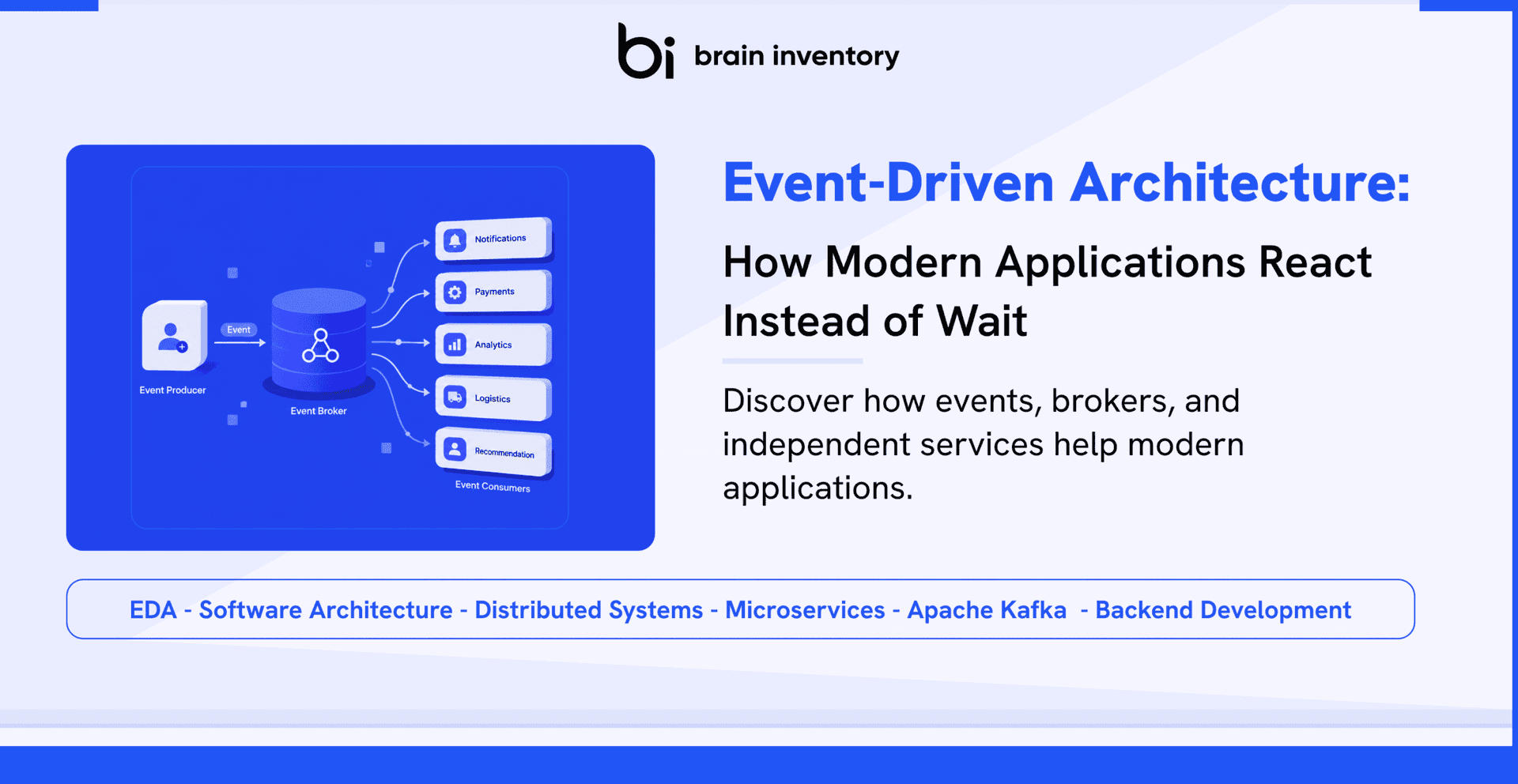
Event Driven Architecture has three main components: event producers, event brokers, and event consumers. Each component has a clear role in moving information through a distributed system.
1. Event producers
An event producer creates and publishes an event when something significant happens. It does not need to know which services will receive that event or what they will do next. For example, a ride service can publish an event when a customer books a ride. An online store can publish an event after a customer places an order. A streaming service can create events when users start or stop watching content.
2. Event brokers
An event broker delivers events to the services that need them. Tools such as Apache Kafka, RabbitMQ, Amazon Kinesis, and Google Pub/Sub provide messaging and event-streaming capabilities. Think of a broker as a postal service: producers send messages without needing to know every recipient.
Kafka, for example, organizes event streams into topics. Multiple services can read from the same topic independently, and they do not all need to process an event at the same time. The exact delivery and retention behaviour depends on the technology and its configuration.
3. Event consumers
Event consumers listen for relevant events and run their own business logic when those events arrive. A notification service might email a customer after an order. A recommendation engine might update a user profile after a movie. A fraud detection service might analyze payment activity for suspicious patterns.
Together, these components create a straightforward flow: a producer publishes an event, a broker routes it, and one or more consumers respond. Each component handles a defined responsibility, so teams can add services without redesigning the entire application.
Why Event Driven Architecture Scales Better Than Traditional Systems
EDA becomes especially useful as an application handles more users and more activity. Consider an online store. In a traditional request-response chain, the Order Service calls the Payment Service. Payment then contacts Inventory, Inventory contacts Shipping, and Shipping triggers customer notifications. Each step may depend on the previous one finishing first.
Reducing dependencies between services
This design can work for small applications, but it becomes harder to manage as traffic increases. During shopping events such as Prime Day or Black Friday, a slowdown in one service can delay the rest of the workflow.
With EDA, the Order Service can publish an “Order Placed” event. Payment, inventory, shipping, notifications, fraud detection, and analytics services can subscribe and carry out their tasks independently. The Order Service does not need to know which consumers exist or how many will respond.
Scaling and evolving more easily
This separation lets teams scale individual services based on demand. It also helps services recover from some failures without blocking every other process. When a business adds a new capability, developers can often create a new consumer for an existing event instead of changing the original producer. Teams still need to design for delivery guarantees, retries, and failures, but the architecture can reduce unnecessary dependencies.
Event Driven Architecture vs. Request-Response Architecture
Event Driven Architecture does not replace APIs or traditional request-response communication. The two approaches solve different problems, and modern applications often use both.
When request-response works best
Request-response communication works well when a user expects an immediate answer. Logging in, searching for products, retrieving account information, and checking a bank balance all require a direct response. APIs remain a practical choice for these interactions because the client sends a request and receives a result.
When event-driven communication works best
After a customer places an order, several follow-up tasks may need to happen. The system must update inventory, prepare shipping information, send notifications, check for fraud, refresh recommendations, and record analytics. An event can trigger these independent workflows without making the user wait for every task to finish.
In many applications, APIs handle direct user interactions while events coordinate background work. Together, they help applications stay responsive while supporting complex backend processes.
When Should You Use Event Driven Architecture?
EDA does not suit every project. Event brokers, asynchronous messaging, and distributed processing introduce extra complexity. A simple portfolio site, static website, internal dashboard, or basic CRUD application may work better with straightforward request-response communication.
EDA becomes more useful when several services need to react to the same business action, when the application needs real-time processing, or when separate teams manage different services. It can also help when components need to scale independently or when the system must continue handling work despite certain service failures.
Before adopting EDA, consider the problem you need to solve. If direct calls already keep the application simple and reliable, adding an event broker may not provide enough value. Choose the architecture based on your workflows and operational needs, not just because large technology companies use it.
Challenges of Event Driven Architecture
EDA offers scalability benefits, but teams must plan for its operational challenges. One major challenge is debugging. A single event may pass through many independent services, so developers need a clear way to trace its journey and identify failures.
Observability and debugging
Logging, monitoring, correlation IDs, and distributed tracing help teams follow events across services. Without these tools, an issue that spans multiple consumers can be difficult to investigate.
Duplicate delivery and idempotency
Network problems, retries, or temporary outages can cause a system to deliver an event more than once. Consumers should handle duplicates safely. Idempotent processing helps ensure that repeating an operation does not create duplicate orders, payments, or notifications.
Event ordering and consistency
Events may not always arrive in the order developers expect. For example, a consumer could process an “Order Cancelled” event before it handles an earlier “Order Created” event. Teams must define ordering requirements and design appropriate safeguards. Event-driven workflows may also take time to reach a consistent state, so applications should account for that delay.
These challenges do not make EDA a poor choice. They show why event design, monitoring, error handling, and clear operational practices matter as systems grow.
Common Mistakes Teams Make
Some organizations adopt EDA simply because large technology companies use it. That choice can add complexity without solving a real problem. One common mistake is creating events for every minor action instead of focusing on meaningful business events. Another is introducing a tool such as Kafka before the application needs asynchronous communication.
Teams can also overlook event versioning, which makes schema changes difficult later. Poor retry strategies and missing dead-letter queues can leave failed events unnoticed. Finally, teams sometimes assume that events will always arrive in the right order.
Successful event-driven systems start with clear event definitions and simple workflows. Teams then add reliable retries, monitoring, versioning, and failure handling where the use case requires them. Not every process needs to become asynchronous.
How AI Is Making Event Driven Architecture Even More Important
AI-powered applications often rely on several services that perform different tasks. Event Driven Architecture can help coordinate these tasks without tightly connecting every component.
Coordinating AI-powered workflows
Imagine a customer submitting a complaint through an online support portal. The application can publish a “Complaint Received” event. Several services can respond: one analyzes sentiment, another searches the knowledge base, a third reviews historical support tickets, and another calculates priority and routes the issue to the right team.
Each service can focus on its own task while responding to the same event. This approach can support AI agents and multi-agent workflows, especially when teams need to coordinate independent steps. Developers still need to manage permissions, errors, data quality, and the decisions these systems make. Events provide the communication structure; they do not remove the need for careful AI system design.
Conclusion
Behind a simple user interaction, many independent systems may work together. Booking a ride, streaming a movie, or purchasing a product can trigger several backend processes at once. Event Driven Architecture helps coordinate this work by allowing services to communicate through events rather than relying only on direct, sequential calls.
This approach can reduce dependencies, support independent scaling, and make it easier to add new capabilities. It also brings challenges around observability, duplicate events, ordering, and failure handling. Teams should weigh those trade-offs and adopt EDA when their application genuinely benefits from asynchronous, event-based workflows.
Build Scalable Software with Brain Inventory
Planning a scalable backend or modernizing a distributed application? Brain Inventory helps businesses build software solutions around their product goals, technical requirements, and growth plans. From backend development to custom software engineering, the right architecture starts with understanding the problem your system needs to solve.
Ready to build a software solution that can grow with your business? Connect with Brain Inventory to discuss your project and explore the right development approach for your needs.

Have an idea?
Get in touch, we’d be
happy to hear from you
We are always looking out for new collaborations, whether you are a client who is passionate about a project or a talent who is interested in joining our team, our doors are always open.
locate us

India (HQ)
618, Shekhar Central, Palasia Square, A.B Road, Indore, Madhya Pradesh, 452001
+918109561401

United Kingdom
Brain Inventory, SBVS, 8 Roundhay Road, Leeds, UK, LS7 1AB
+18008209286

Canada
44 Main Street East Milton, ONCanada L9T 1N3
+4166696505

Jordan
185 Wasfi Al-Tal Street, Ammon Oasis Complex P.O Box 4724 Amman 11953 Jordan
+960770781000

USA
720 Seneca St Ste 107 Seattle, USA 98101
+1(206)6533419
if it's digital,we'll make it.
- Numetric - Online Accounting Software similar to QuickBooks
- Bloomia - Kegel exercise
- Virifi - Blockchain Powered Document Certification & Signing Platform
- Revolution Travel CRM - Custom CRM Built for Travel Agents
- Fatoura - Online Invoicing Platform
- My Fit Mantra - Your health partner
- Ocureel - Relation Building and video sharing Application




Follow us:


