OAuth vs OpenID Connect: Key Differences Explained
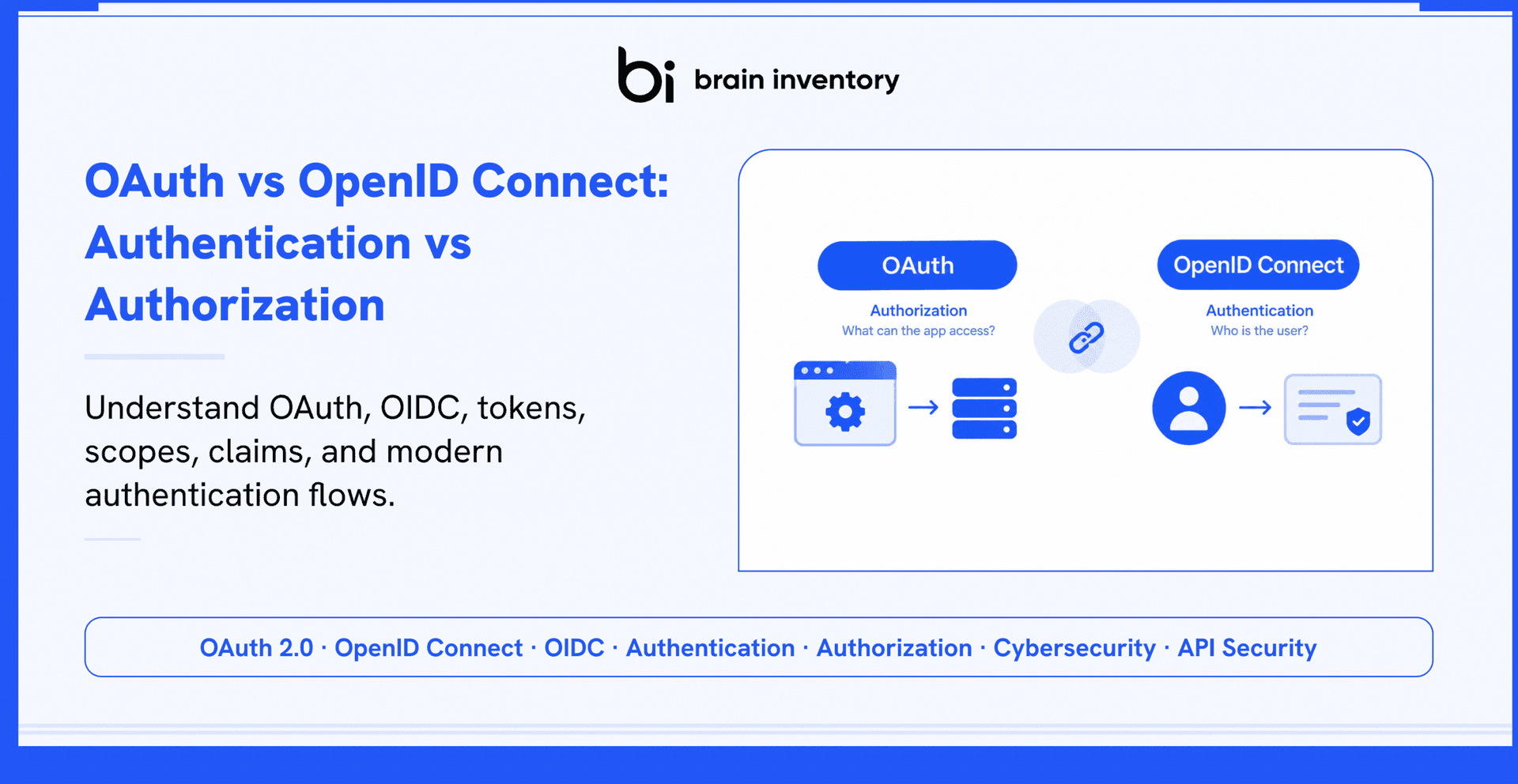
When you click “Sign in with Google” on a website, the entire process feels almost instant. You choose your account, approve access if the application asks for it, and return to the website. However, several things happen behind that simple interaction. The identity provider may verify your identity, the application may request permissions, the authorization server may exchange an authorization code, and the system may issue tokens that later grant access to protected APIs.
This is where OAuth and OpenID Connect (OIDC) often become confusing. Both technologies appear in modern authentication systems, both can support the same login experience, and both rely on tokens. However, they serve different purposes. OAuth primarily handles authorization, while OpenID Connect adds an authentication and identity layer on top of OAuth 2.0. Understanding this distinction matters because developers can create serious security problems when they treat OAuth as a complete login protocol, use access tokens as identity tokens, or skip important validation steps.
The easiest way to understand OAuth vs OpenID Connect is to stop viewing them as competing technologies. Instead, consider the problem each one solves. Authentication answers “Who are you?” while authorization answers “What are you allowed to access?” Once you understand this difference, concepts such as ID tokens, access tokens, scopes, claims, PKCE, SSO and OAuth flows become easier to connect.
OAuth vs OpenID Connect: What’s the Difference?
OAuth 2.0 solves a delegated authorization problem. Imagine an application wants to access your Google Calendar. You may want to give that application permission to read your calendar, but you certainly do not want to share your Google password with it. OAuth provides a framework that lets the application obtain limited access to a protected resource without collecting your login credentials.
OpenID Connect addresses a different requirement. An application may also need to identify the person who signs in. OAuth alone does not provide a standardized identity layer for this purpose. OIDC builds on OAuth 2.0 and introduces standardized authentication mechanisms, including the ID token. This token contains claims about the authenticated user and the authentication event.
The two technologies differ in several important ways:
- Primary purpose: OAuth 2.0 handles authorization, while OpenID Connect handles authentication and identity.
- Main question: OAuth answers what an application can access. OIDC helps establish who the user is.
- Main token: OAuth uses access tokens to grant access to protected resources. OIDC introduces ID tokens to communicate identity information.
- Foundation: OpenID Connect builds on the OAuth 2.0 framework.
- Common example: OAuth lets an application access your calendar. OIDC supports experiences such as signing in with Google.
- Identity claims: OAuth does not standardize identity claims for login. OIDC defines standardized claims for this purpose.
The distinction becomes particularly important when applications use OAuth and OIDC together. For example, a web application might use OIDC to authenticate a user through an identity provider. At the same time, it can use OAuth mechanisms to obtain an access token that allows it to call a protected API. Both operations can happen within the same workflow, but they still serve different purposes.
Why Was OpenID Connect Created If OAuth Already Exists?
The easiest way to understand OIDC is to look at what OAuth does not attempt to solve. OAuth focuses on delegated access. Its goal is to let a client obtain permission to access a protected resource. It does not standardize how applications establish a user’s identity.
Suppose a user authorizes an application to access a resource. The application now has permission, but that permission alone does not provide a standardized identity assertion about the person who approved the request. Different implementations could use different methods to retrieve user information, which made interoperability more difficult.
OpenID Connect addresses this gap by adding a standardized identity layer on top of OAuth 2.0. It defines how an application can authenticate a user and retrieve information about that authentication through standardized claims and an ID token. This is why developers often describe OIDC as an identity layer built on OAuth 2.0, rather than a completely separate protocol.
You can understand their relationship through three simple points:
- OAuth 2.0: Provides delegated authorization and access to protected resources.
- OpenID Connect: Adds authentication and standardized identity information.
- OAuth + OIDC: Combines user authentication with authorized API access.
This also answers a common question: Is OIDC a replacement for OAuth? No. OIDC depends on OAuth 2.0 concepts and extends them to support authentication.
Authentication vs Authorization: Why the Difference Matters
People often mention authentication and authorization together, but these processes serve different purposes. Authentication establishes the identity of an entity. It answers whether someone is actually the user they claim to be. Authorization determines which resources that user, application or service can access.
Consider a project management application that lets you sign in with your Google account. Google verifies your identity, and the application receives standardized information about your authenticated account. That process represents authentication. Later, the application might ask for permission to access your Google Calendar. This request involves authorization because the application wants access to a specific resource.
The distinction matters because an application can receive permission to access a resource without OAuth becoming an authentication protocol. Simply receiving an access token also does not prove a user’s identity. The token represents authorization for a resource, while OIDC provides standardized mechanisms to establish user identity.
ID Token vs Access Token
One of the most important concepts in OAuth and OpenID Connect involves understanding the difference between an ID token and an access token. Both tokens may appear during the same overall flow, but they serve different purposes and target different consumers.
An ID token belongs to the OIDC authentication layer. It provides information about the authentication event and the user associated with it. Standard OIDC claims can include the issuer (iss), subject (sub), audience (aud), issued-at time (iat) and expiration (exp). Depending on the requested scopes and the identity provider, the token may also include additional claims such as email or profile information.
An access token serves a different purpose. A client presents this token when it needs to access a protected resource, typically through an API. The API checks the token to determine whether the request has the required authorization. An access token may use the JWT format, but OAuth does not require every access token to follow the same format.
Remember the distinction this way:
ID token: Provides information about authentication and identity.
Access token: Grants authorization to access a protected resource.
Developers should avoid using an access token as a substitute for an ID token. Likewise, they should not send an ID token to an API simply because it contains user information. Each token has an intended audience, purpose and set of validation requirements.
How OAuth and OIDC Work Behind the Scenes
The familiar “Sign in with Google” experience usually involves several redirects, authorization requests, code exchanges and token validations. Users see a login screen, while the application and authorization server exchange information in the background.
A simplified Authorization Code Flow looks like this:
- The user selects the login option in the application.
- The application redirects the user to the authorization server.
- The user authenticates with the identity provider.
- The authorization server processes the requested permissions.
- The authorization server redirects the user to the application with an authorization code.
- The client exchanges that code for tokens.
- OIDC provides an ID token containing identity information.
- The application can use an access token to access a protected API.
- The application validates the relevant tokens and claims.
- Finally, the application creates its own authenticated session for the user.
The authorization code itself does not grant the final permission to access an API. Instead, it acts as an intermediate credential that the client can exchange for tokens under the appropriate conditions. This design helps keep sensitive tokens away from the browser redirect whenever possible. It also gives the application additional opportunities to verify that the request is legitimate.
What Is PKCE and Why Does OAuth Use It?
PKCE, or Proof Key for Code Exchange, is an important security extension to the Authorization Code Flow. It addresses scenarios where a client cannot safely store a traditional client secret, such as many mobile, native and browser-based applications.
The mechanism starts when the client creates a code_verifier and derives a code_challenge from it. The client sends this challenge as part of the authorization request. Later, when the client exchanges the authorization code for tokens, it provides the original verifier. The authorization server checks the verifier to confirm that the same party initiated the request and now wants to exchange the code.
This approach adds an important layer of protection. Even if someone intercepts the authorization code, that person should not be able to exchange it for tokens without the corresponding verifier.
For modern applications, Authorization Code Flow with PKCE deserves attention as a core security practice rather than an optional technical detail. Developers should understand its role, particularly when building single-page applications, mobile applications and other public clients.
OAuth 2.0 vs OAuth 2.1
Developers researching OAuth often come across another comparison: OAuth 2.0 vs OAuth 2.1. This distinction is less about learning an entirely new authentication technology and more about understanding how modern OAuth security practices have evolved.
OAuth 2.1 consolidates recommended practices and moves away from older approaches that developers should no longer use in new applications. The practical takeaway is to follow secure, current implementation patterns instead of choosing a flow simply because an older tutorial demonstrates it.
The application type generally influences the appropriate approach:
- Traditional server-side web applications: Authorization Code Flow.
- Single-page applications: Authorization Code Flow with PKCE.
- Mobile and native applications: Authorization Code Flow with PKCE.
- Machine-to-machine applications: Client Credentials Flow.
This also explains why older tutorials can mislead developers. OAuth implementations have evolved, so developers should carefully review the security assumptions behind older flow diagrams and code examples before reusing them.
Scopes vs Claims: What’s the Difference?
Scopes and claims often create confusion because OAuth and OIDC use both concepts. Although they relate to the same broader identity and access process, they describe different things.
A scope represents a requested area of access or information. For example, an application might request:
openid profile email
A claim, on the other hand, provides information about a user or authentication event. Common examples include:
subnameemailemail_verified
A simple way to remember the distinction is that scopes describe what an application requests, while claims describe information the identity provider can return about the user or authentication context.
The openid scope plays a particularly important role because it identifies the request as an OpenID Connect authentication request rather than a simple OAuth authorization request. Other standard OIDC scopes, such as profile and email, let the client request additional categories of identity claims.
State, Nonce and Token Validation
OAuth and OIDC do not become secure simply because they use tokens. The surrounding request and validation process matters just as much.
The OAuth state parameter helps the client connect an authorization response to the request that initiated it. This becomes particularly important when the application needs to protect the authorization flow from unexpected or forged responses.
OIDC introduces another important value called nonce. The client associates this value with the authentication request and the resulting ID token. It can then compare the returned nonce with the original value to verify that the ID token corresponds to the authentication request it initiated.
Token validation also plays a critical role. Developers can decode a JWT easily, but decoding does not establish trust. An application must verify the token’s signature and inspect relevant claims before relying on its contents.
Important validation checks include:
- Whether the issuer matches the expected identity provider.
- Whether the audience matches the intended application.
- Whether the token has expired.
- Whether the cryptographic signature is valid.
- Whether the expected nonce appears and matches when applicable.
- Whether the application uses the token for its intended purpose.
OIDC Discovery simplifies this process by providing standardized metadata about an identity provider. The discovery document identifies endpoints such as the authorization endpoint, token endpoint, UserInfo endpoint and JWKS URI. The JWKS endpoint provides public keys that applications can use to verify signed tokens.
This highlights an important difference between decoding a token and validating a token. A JWT might contain a user’s email address, but that information alone does not prove that a trusted authority issued the token.
What Is the OIDC UserInfo Endpoint?
OIDC also defines a UserInfo endpoint, which gives clients another standardized way to retrieve claims about an authenticated user. The client typically calls this endpoint with an access token that the identity provider issued for the appropriate resource.
Developers sometimes assume that the ID token must always contain every detail they need about a user. However, OIDC provides multiple mechanisms for retrieving standardized identity information. The exact approach depends on the flow, requested scopes and identity provider.
Understanding the difference between the ID token and UserInfo endpoint becomes particularly useful when building an actual OIDC integration rather than simply adding a “Sign in” button.
OAuth vs OIDC vs SAML
OAuth and OIDC are not the only protocols involved in modern identity systems. SAML is another major technology, particularly in enterprise environments where organizations use centralized identity providers for employee authentication and Single Sign-On.
Each technology serves a different purpose:
- OAuth: Focuses on authorization and delegated access to resources, such as APIs.
- OIDC: Adds authentication and identity capabilities to OAuth. Applications commonly use it for login and SSO.
- SAML: Supports identity federation and enterprise SSO, particularly in organizations with established enterprise identity infrastructure.
The right choice depends on the environment rather than the assumption that one protocol works better in every situation. A new consumer-facing application may naturally use OIDC, while an enterprise organization with established SAML infrastructure may continue using SAML for specific integrations.
Can OAuth Work Without a User?
Yes. This is an important point because many explanations of OAuth focus almost entirely on user login.
OAuth can also support communication between services without involving a human user. The Client Credentials Flow handles this type of machine-to-machine authorization.
The basic relationship looks like this:
Service A
↓
Authorization Server
↓
Access Token
↓
Service B / API
For example, a backend service might need to call another internal API. Instead of asking a human to log in, the service authenticates as a client and obtains an access token with the permissions required by that API.
Developers commonly use this flow for backend integrations, microservices, automated processes and service-to-service communication. It reinforces one of the most important lessons in this topic: OAuth is not simply a login technology.
How OIDC Enables Single Sign-On
OpenID Connect also plays an important role in Single Sign-On (SSO). Instead of maintaining a completely independent authentication experience for every application, organizations can let several applications rely on the same identity provider.
The identity provider handles authentication, while individual applications act as relying parties that trust the identity information OIDC provides.
A simplified architecture might look like this:
Identity Provider
↓
App A | App B | App C
This architecture allows organizations to centralize authentication while letting multiple applications participate in the same identity ecosystem. That capability makes OIDC particularly relevant to modern application SSO.
Common OAuth and OIDC Security Mistakes
Most OAuth and OIDC problems do not come from the protocols themselves. They usually arise when developers implement them incorrectly or misunderstand what a particular token or parameter represents.
Common mistakes include:
- Treating OAuth as a complete user authentication protocol.
- Using an access token as proof of user identity.
- Sending an ID token to an API instead of an access token.
- Skipping PKCE in application types where the flow should use it.
- Failing to validate ID token signatures.
- Ignoring the
issandaudclaims. - Failing to validate
stateornonce. - Requesting more permissions than the application actually needs.
- Assuming every access token follows the JWT format.
- Trusting token contents simply because the application can decode them.
The principle of least privilege deserves particular attention. If an application only needs read access to a resource, it should not request broad permissions that allow unrelated actions. Smaller scopes reduce the potential impact if someone exposes or misuses a token.
OAuth and OIDC for AI Agents
The rise of AI agents creates another environment where identity and authorization matter. An AI agent that can access an API, send an email, update a CRM record or retrieve internal documents needs more than the ability to generate a response. It also needs clearly defined permissions and a way for the receiving system to identify who or what makes the request.
OAuth provides a natural foundation for delegated access and scoped permissions. OIDC can contribute identity information when an application needs to authenticate a user or agent. Although the exact architecture continues to evolve, the underlying principle remains familiar: an actor should receive only the access required to perform its task.
For AI-enabled applications, this makes short-lived credentials, scoped permissions, delegation, token validation and explicit authorization increasingly important. As agents gain the ability to take actions rather than simply produce text, the distinction between identity and permission becomes even more significant.
OAuth or OIDC: Which One Should You Use?
The decision becomes much easier when you focus on the problem your application needs to solve.
If the application needs to authenticate a user, OpenID Connect provides the relevant identity layer. If it needs to authorize access to a protected API or resource, OAuth provides the authorization framework. Applications that need both can use OAuth and OIDC together as part of the same architecture.
For service-to-service communication without a human user, OAuth Client Credentials may be appropriate. Enterprise SSO may call for OIDC or SAML, depending on the organization’s existing identity infrastructure and application requirements.
The important thing is not to ask which protocol is “better.” Instead, ask what does the application actually need to prove, and what does it need permission to access?
Final Takeaway
OAuth and OpenID Connect appear together so often that developers may mistake them for two versions of the same technology. However, they solve different problems. OAuth provides a framework for delegated authorization, while OIDC adds standardized authentication and identity capabilities on top of OAuth 2.0.
Once you understand this relationship, the rest of the ecosystem becomes easier to follow. Access tokens authorize access to protected resources. ID tokens provide identity information. Scopes describe requested access. Claims provide information about an identity. PKCE strengthens the authorization code exchange. State and nonce help protect the flow. Discovery and JWKS support token validation.
The most useful way to remember the entire topic is simple: OAuth answers what an application can access, while OpenID Connect helps establish who the user is. Modern applications often need both. Understanding where one responsibility ends and the other begins helps developers build authentication and authorization systems that remain functional and secure.
Building Secure, Scalable Applications? Let’s Talk.
Choosing the right authentication and authorization approach is only one part of building a secure application. You also need the right architecture, reliable integrations and security practices to protect your users and data.
At Brain Inventory, we help businesses build secure, scalable and high-performing software solutions tailored to their needs. Whether you’re developing a new application, integrating identity management or strengthening your existing systems, our team can help you get it right.
Ready to build smarter and more secure software? Get in touch with Brain Inventory and let’s discuss your project.

Have an idea?
Get in touch, we’d be
happy to hear from you
We are always looking out for new collaborations, whether you are a client who is passionate about a project or a talent who is interested in joining our team, our doors are always open.
locate us

India (HQ)
618, Shekhar Central, Palasia Square, A.B Road, Indore, Madhya Pradesh, 452001
+918109561401

United Kingdom
Brain Inventory, SBVS, 8 Roundhay Road, Leeds, UK, LS7 1AB
+18008209286

Canada
44 Main Street East Milton, ONCanada L9T 1N3
+4166696505

Jordan
185 Wasfi Al-Tal Street, Ammon Oasis Complex P.O Box 4724 Amman 11953 Jordan
+960770781000

USA
720 Seneca St Ste 107 Seattle, USA 98101
+1(206)6533419
if it's digital,we'll make it.
- Numetric - Online Accounting Software similar to QuickBooks
- Bloomia - Kegel exercise
- Virifi - Blockchain Powered Document Certification & Signing Platform
- Revolution Travel CRM - Custom CRM Built for Travel Agents
- Fatoura - Online Invoicing Platform
- My Fit Mantra - Your health partner
- Ocureel - Relation Building and video sharing Application




Follow us:


