Feature Flags Explained: How Netflix Releases Features Safely
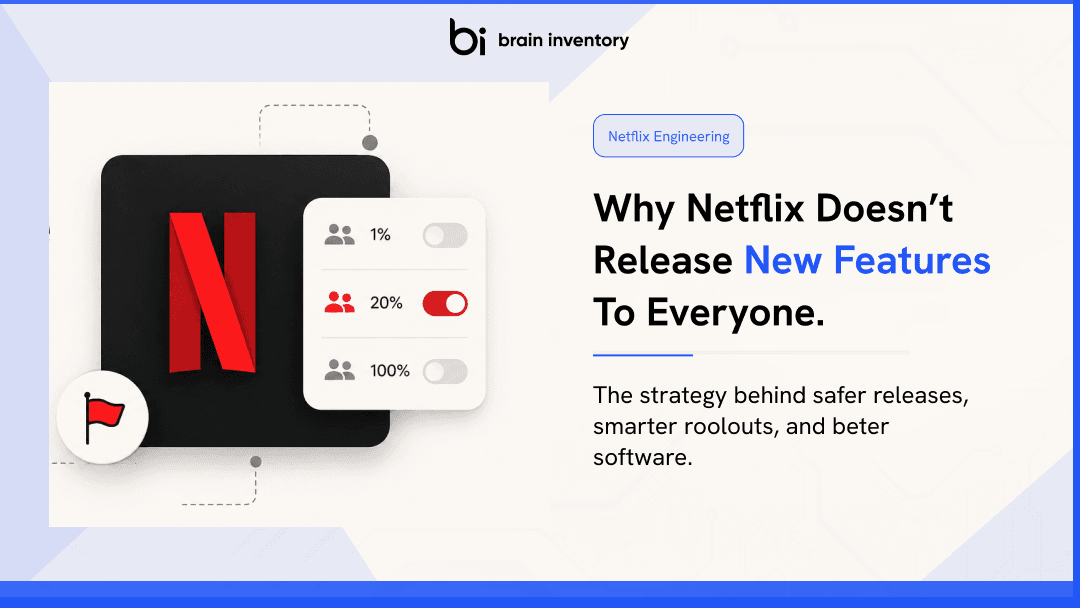
Feature flags are an important part of modern software development. They allow engineering teams to release new functionality gradually without disrupting the user experience. Software updates often appear simple from the outside. You install the latest version of an app and expect everyone using the same version to have the same experience. In reality, modern software rarely works that way.
Imagine watching Netflix with a friend on the same evening. They mention a redesigned homepage that makes discovering new shows easier. Curious, you open your own Netflix app, only to find that your homepage looks exactly the same. Both of you have the latest app version installed, yet you see two completely different experiences.
Most people assume this difference indicates a bug or an incomplete update. However, it may result from a deliberate software release strategy powered by feature flags. Companies such as Netflix, Amazon, and Spotify use controlled release strategies to deploy new functionality behind the scenes. They expose it to selected users, monitor its performance in real-world conditions, and gradually expand availability when the results meet expectations. This approach has changed how modern engineering teams build, test, and release software.
The Biggest Misconception About Software Releases
Many people believe software development follows a straightforward sequence. Developers build a feature, testers verify it, engineers deploy it to production, and users immediately receive the update. However, modern software engineering separates two activities that people often confuse: deployment and release.
Deployment means making a version of the code available in a production environment. Release means allowing users to access and use the new functionality. Although these activities can happen simultaneously, they do not have to. In traditional software delivery, deployment often makes new functionality available to every customer immediately. This leaves little room to control exposure when unexpected problems arise.
Production environments are also difficult to reproduce perfectly during testing. A feature may pass automated tests and quality assurance checks but behave unexpectedly when millions of real users interact with it. External APIs may respond differently under heavy workloads. Network conditions can vary across regions, and customer behavior may reveal problems that developers did not anticipate.
Modern engineering teams therefore focus on more than preventing bugs before deployment. They also work to limit the impact of unexpected problems after deployment. Separating deployment from release gives organizations greater flexibility to manage changes without necessarily rolling back an entire application update.
How Netflix Releases New Features Safely
Imagine Netflix developing a new recommendation engine to help users discover movies and television shows. The engineering team spends months improving content suggestions, testing performance, and evaluating the potential impact on content discovery. Although the feature performs well in controlled tests, releasing it to every subscriber immediately could still introduce risks.
Users might interact with recommendations differently than expected. Page loading times could increase in certain regions, or an issue might emerge when the system handles millions of simultaneous requests. Even extensive testing cannot guarantee that every feature will behave perfectly in a live production environment.
Instead of exposing the new functionality to everyone at once, a company could deploy the recommendation engine behind a feature flag. The code would exist in production, but the flag would determine whether users could access the new experience. Engineers could begin with a limited rollout, observe application performance and customer engagement, and expand availability when the results meet expectations.
If the feature causes problems, the team could disable the flag to stop exposing the new functionality, provided the application supports a safe fallback. This approach separates shipping code from making functionality available to customers. It gives engineering teams greater control over the release process. This example illustrates how a streaming platform could use feature flags; it does not claim to describe Netflix’s specific internal implementation.
What Are Feature Flags?
A feature flag, sometimes called a feature toggle, is a software mechanism that allows developers to enable or disable specific functionality without necessarily changing the application’s code or performing another deployment. Think of it as a light switch in a house. The electrical wiring and light fixtures are already installed, but the lights remain off until someone flips the switch.
Feature flags work similarly. The software contains the new functionality, while a conditional rule determines whether users can see or use it. Depending on the implementation, that rule might control access for individual users, customer groups, geographic regions, subscription plans, or a percentage of the eligible audience.
This flexibility changes how engineering teams approach software delivery. Developers can deploy code while keeping unfinished functionality hidden. Product managers can coordinate releases around business requirements, and quality assurance teams can validate specific experiences before a wider launch.
Teams can also use feature flags to manage experiments, provide early access to selected customers, or disable certain functionality when problems arise. However, feature flags do not eliminate the need for software testing, secure development, or reliable architecture. Their primary benefit is greater control over feature availability throughout development, experimentation, and release.
Feature Flags and Progressive Rollouts: Why They Are Safer
One of the most common uses of feature flags is enabling progressive rollouts. This release strategy introduces new functionality to an increasing proportion of eligible users over time. Instead of launching a feature to every customer simultaneously, a company might begin with an internal testing group or a small percentage of its audience.
Engineers then monitor application errors, response times, service reliability, conversion rates, and user engagement. These indicators help them determine whether the change behaves as expected. If performance remains healthy, the rollout can expand to a larger audience in stages until the feature reaches all intended users. This gradual approach helps teams identify unexpected problems before they affect the entire customer base.
For example, a company might initially enable a new feature for one percent of eligible users. It could then expand availability to five percent, twenty percent, fifty percent, and eventually the full audience. These percentages are illustrative rather than a universal rollout schedule. The appropriate stages depend on the application’s risk, architecture, traffic, and business requirements.
If monitoring reveals a serious issue, engineers can pause the rollout or disable the feature flag. This can reduce the number of users exposed to a problematic feature and simplify mitigation, provided the application supports a safe fallback. However, disabling a flag will not automatically resolve every infrastructure problem or reverse changes already made to databases and external systems. Effective progressive rollouts therefore combine feature flags with automated testing, application monitoring, and a clear incident response process.
Feature Flags Are More Than a Safety Mechanism
Feature flags do more than reduce deployment risk. They can also help organizations make better product decisions by showing how users respond to different experiences. Businesses regularly evaluate whether a redesigned interface, a new checkout process, a recommendation algorithm, or an additional application capability improves the customer experience.
Internal discussions and design assumptions can provide useful direction, but they cannot always predict real-world behavior. Feature flags allow teams to expose different experiences to selected groups and evaluate the results using predefined measurements. When combined with a properly designed experiment, this approach supports A/B testing and helps product teams make decisions based on observed customer behavior rather than assumptions alone.
Consider a streaming service comparing two homepage designs. One group receives larger content thumbnails, while another continues using the existing layout. The company can examine content discovery, engagement, and the number of users who start watching recommended titles. Reliable conclusions also require appropriate audience selection, accurate measurement, and consideration of statistical uncertainty.
Beyond A/B testing, feature flags can support beta programs, early-access releases, regional launches, and limited previews for selected customers. By controlling who can access a new capability, businesses can collect feedback, evaluate product hypotheses, and validate assumptions before a broader release. This makes feature flags valuable for engineering reliability, product experimentation, and continuous improvement.
How Feature Flags Improve Team Collaboration
Feature flags help development, product, marketing, sales, and quality assurance teams work more independently. Developers can complete a feature before the marketing team announces its launch. Product managers can coordinate availability around customer needs, while sales teams can provide selected enterprise customers with early access to approved capabilities.
Regional teams can also validate localized experiences before expanding availability globally. These arrangements allow organizations to coordinate product development and commercial activities without making every department dependent on a single deployment date. Teams can prepare releases in advance while retaining control over when specific functionality becomes available.
This separation supports Continuous Delivery, a software engineering practice that keeps code in a deployable state and allows teams to release it reliably when appropriate. Engineers can integrate changes frequently, deploy them through established pipelines, and control unfinished or newly developed functionality through feature flags.
However, feature flags are only one component of an effective delivery strategy. Automated testing, code reviews, monitoring, deployment automation, and sound architectural decisions remain essential. When these practices work together, organizations can deliver improvements more frequently while maintaining control over how changes reach customers.
Businesses planning to build or modernize digital products can explore Brain Inventory’s software development services to learn more about developing and maintaining software applications.
The Hidden Cost of Feature Flags
Despite their advantages, feature flags introduce additional complexity when teams do not manage them carefully. Each flag adds another condition that developers must understand, test, and maintain. As a software product evolves, temporary flags can accumulate across multiple components and increase the number of possible application behaviors.
When teams forget to remove flags after completing a rollout, developers may encounter outdated conditions, unnecessary code paths, and dependencies that are difficult to understand. Developers often call these abandoned toggles zombie flags. Over time, they can become a source of technical debt, increase maintenance costs, complicate debugging, and reduce code readability.
Managing this complexity requires a clear lifecycle for every feature flag. Teams should document why a flag exists, identify its owner, and establish a review or removal date when the flag is temporary. Once the rollout finishes and the flag no longer serves a purpose, developers should remove the obsolete condition and any associated code that they no longer need.
Some flags serve permanent operational purposes, such as emergency kill switches or controls for specific system capabilities. Teams should manage these according to their ongoing purpose rather than remove them automatically. Regular reviews, clear ownership, and consistent cleanup practices keep the codebase understandable while preserving the flexibility that feature flags provide.
Best Practices for Using Feature Flags
Successful feature flag management requires more than adding an on-and-off condition to an application. Engineering teams should establish consistent naming conventions, document each flag’s purpose, and assign clear ownership. Temporary flags should have an expected cleanup date, while long-lived operational flags should have appropriate access controls, monitoring, and documented procedures.
Teams should also test both enabled and disabled states. Either path can introduce unexpected behavior if developers have not designed the application to handle the transition correctly. Clear documentation and ownership help prevent flags from being forgotten as teams change and software products evolve.
Progressive rollouts should rely on meaningful performance indicators and clear criteria for expanding, pausing, or reversing a release. Engineers should monitor application errors, latency, business metrics, and relevant customer feedback instead of assuming a rollout has succeeded simply because the application remains available.
Regular reviews can help teams identify unused toggles, unnecessary combinations, and outdated code. Developers must also understand the limitations of disabling a flag: it may hide a feature from users, but it cannot necessarily reverse database migrations, external transactions, or other changes that have already occurred. Combining these practices with automated testing, reliable monitoring, and a well-defined incident response process helps organizations use feature flags effectively while maintaining a dependable codebase.
Why Feature Flags Have Become Essential in Modern Software Development
As software products evolve and release cycles become shorter, engineering teams need reliable ways to introduce new functionality without unnecessarily disrupting existing users. Feature flags provide a mechanism for separating deployment from release, controlling access to new capabilities, and observing their behavior under real-world conditions.
They help teams limit the initial audience for a change, gather feedback, evaluate product hypotheses, and respond quickly when unexpected issues arise. For organizations maintaining complex applications or serving large customer bases, this level of control can be particularly valuable when introducing changes that require careful validation. Feature flags also give teams greater flexibility to coordinate releases with business priorities and customer expectations.
Feature flags encourage a more experimental and evidence-based approach to product development. Rather than assuming every new design or capability will improve the customer experience, businesses can introduce changes to selected audiences, measure meaningful outcomes, and use the findings to guide future decisions.
However, feature flags should not replace software testing, secure development, monitoring, or sound engineering practices. Their greatest value comes from combining controlled feature availability with a reliable delivery process, clear ownership, and disciplined maintenance. When implemented thoughtfully, feature flags help development teams deliver improvements with greater confidence while protecting the stability, performance, and usability that customers expect.
Conclusion
Feature flags have transformed how modern software teams approach releases by allowing them to separate deployment from the moment new functionality becomes available to users. Instead of exposing every change to the entire customer base simultaneously, organizations can introduce features gradually, monitor performance, collect feedback, and adjust availability when necessary.
This approach can reduce the impact of certain release problems while giving product teams more flexibility to test ideas and improve user experiences using real-world evidence. By combining controlled rollouts with effective monitoring and a well-defined release process, engineering teams can manage software changes more deliberately without treating every deployment as a full public launch.
At the same time, feature flags require thoughtful implementation and ongoing maintenance. Unused toggles can increase code complexity, create additional testing requirements, and contribute to technical debt if teams fail to manage their lifecycle. Establishing clear ownership, monitoring rollout performance, and removing obsolete flags helps organizations preserve the benefits of controlled releases without allowing unnecessary complexity to accumulate.
Ultimately, feature flags are not about eliminating bugs or replacing testing. They give organizations greater control over how software reaches users. As Continuous Delivery and rapid release cycles become increasingly important, feature flags remain valuable tools in modern software engineering, helping companies deliver new functionality with confidence while maintaining the reliability users expect.
Learn More About Software Development with Brain Inventory
Building reliable software takes more than writing code. It requires thoughtful architecture, effective testing, a well-planned delivery process, and the ability to adapt as business requirements evolve. Brain Inventory helps businesses turn ideas into digital solutions through software development expertise, modern engineering practices, and technology strategies tailored to their goals.
Whether you are planning a new application, modernizing an existing platform, or improving the way your product is developed and maintained, the right engineering approach can help you build for long-term performance, reliability, and growth. Explore Brain Inventory’s website to learn more about its software development services and digital solutions.
Ready to build your next digital product? Contact Brain Inventory to discuss your project requirements and explore how a tailored software development approach can support your business goals.

Have an idea?
Get in touch, we’d be
happy to hear from you
We are always looking out for new collaborations, whether you are a client who is passionate about a project or a talent who is interested in joining our team, our doors are always open.
locate us

India (HQ)
618, Shekhar Central, Palasia Square, A.B Road, Indore, Madhya Pradesh, 452001
+918109561401

United Kingdom
Brain Inventory, SBVS, 8 Roundhay Road, Leeds, UK, LS7 1AB
+18008209286

Canada
44 Main Street East Milton, ONCanada L9T 1N3
+4166696505

Jordan
185 Wasfi Al-Tal Street, Ammon Oasis Complex P.O Box 4724 Amman 11953 Jordan
+960770781000

USA
720 Seneca St Ste 107 Seattle, USA 98101
+1(206)6533419
if it's digital,we'll make it.
- Numetric - Online Accounting Software similar to QuickBooks
- Bloomia - Kegel exercise
- Virifi - Blockchain Powered Document Certification & Signing Platform
- Revolution Travel CRM - Custom CRM Built for Travel Agents
- Fatoura - Online Invoicing Platform
- My Fit Mantra - Your health partner
- Ocureel - Relation Building and video sharing Application




Follow us:


