AI Agents vs AI Workforces What is the Difference?
Artificial intelligence continues to evolve. New models offer better reasoning, coding, research, and automation capabilities. Many people once believed that one powerful AI system could handle almost any business task.
That idea seemed reasonable. A single AI could write code, analyze data, create presentations, draft emails, and develop marketing content. It could even help schedule meetings. So, why would businesses need anything more?
The industry began to explore a different approach. Instead of asking how to make one AI smarter, organizations started asking whether one AI should handle every task.
This shift explains the evolution from AI assistants to AI agents and AI workforces. These terms may sound similar, but they describe different approaches to automation. The key difference lies in how AI systems organize work. Rather than relying on one system, businesses can combine specialized AI agents to achieve larger goals.
The Problem Was Never Intelligence
Imagine your company is preparing to launch a new product. Your team must research the market, define requirements, design the user experience, develop the application, and test its quality. Someone must also prepare documentation, coordinate marketing, and monitor customer feedback after launch.
Now imagine asking one employee to handle every responsibility.
They might complete the work, but switching between roles would create challenges. Writing code requires a different mindset from planning a marketing campaign. Reviewing customer feedback also demands a different approach. Each task requires its own context, priorities, and expertise.
Businesses have understood this challenge for decades. Successful organizations rely on specialists who collaborate toward shared goals. They do not expect one person to master every discipline.
Early AI development focused heavily on expanding the capabilities of individual models. As AI matured, businesses began exploring another approach. They realized that intelligence alone could not solve every operational challenge. Work organization mattered just as much.
The same principle applies to AI. A more capable model does not automatically create a more efficient business. Sometimes, building a coordinated team of specialized systems offers a better solution.
From AI Assistants to AI Agents
Understanding AI workforces starts with the evolution of AI itself.
Early AI tools primarily acted as assistants. They answered questions, summarized documents, translated content, and helped users complete everyday tasks. These tools improved productivity, but people still needed to guide most steps.
AI agents introduced a different approach.
Instead of simply responding to prompts, AI agents can pursue defined objectives. For example, an AI assistant might suggest websites for competitor research or summarize information you provide. An AI agent can search websites, compare products, organize findings, and prepare a structured report.
With the right tools and permissions, an agent can complete much of this work independently. It can also evaluate results and adjust its approach when necessary.
This development marked an important change. AI began moving beyond answering questions and toward executing tasks.
Many people saw autonomous agents as the next major step in AI. After all, an agent could plan activities, use tools, and manage complex workflows. But businesses still faced another challenge.
Most business processes require several types of expertise. One agent may handle a task effectively, but a complete workflow often requires multiple roles to work together.
If AI Agents Are So Capable, Why Build AI Workforces?
Consider the product launch example again.
A single AI agent might gather requirements, plan interfaces, write code, test features, prepare campaigns, and analyze performance. However, each responsibility demands different knowledge and priorities.
Managing all these responsibilities through one agent can introduce complexity. The agent must maintain context, switch between roles, and coordinate different stages of work.
Now consider a different approach.
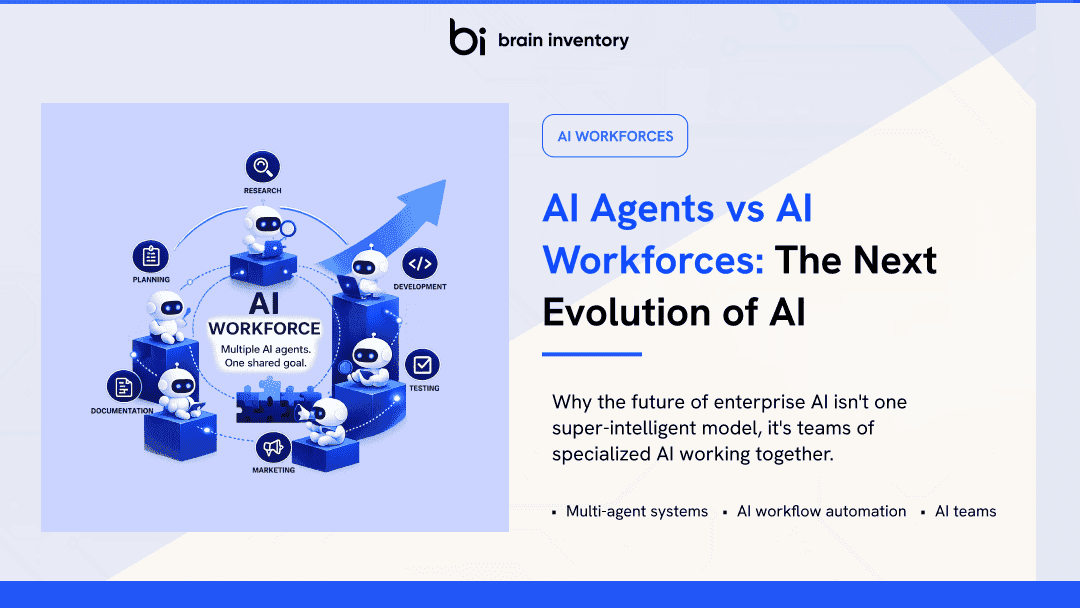
One AI agent researches the market. Another defines the project plan. A development agent builds the software, while a testing agent checks its functionality. Another agent prepares documentation, and a marketing agent develops the launch campaign. An analytics agent then monitors business performance.
Each agent handles a defined responsibility. The system coordinates their work toward one shared objective.
This approach forms the foundation of an AI workforce. It does not depend on one model doing everything. Instead, it combines specialized agents into a coordinated system.
What Exactly Is an AI Workforce?
An AI workforce is a coordinated team of AI agents that works together to complete a broader business process. Each agent handles specific tasks and contributes to a shared outcome.
Think of a modern organization. Product managers define requirements, designers create interfaces, and developers build features. Quality assurance teams test functionality, while marketing teams prepare campaigns. Customer support teams then help users after launch.
Each department brings different expertise to the process. Yet every team contributes to the same business objective.
An AI workforce follows a similar structure. Specialized agents handle individual responsibilities and share their outputs with other agents. An orchestration system can coordinate their tasks, manage dependencies, and keep the workflow moving.
For example, a research agent might identify customer needs. A planning agent can use those findings to define product requirements. A development agent can then build the product, while a testing agent checks its performance.
The workflow continues as each agent completes its assigned tasks. Human oversight can guide important decisions, resolve exceptions, and review critical outputs.
In simple terms, an AI agent focuses on a task or goal. An AI workforce coordinates multiple agents to complete a larger process.
AI Agents vs AI Workforces: Key Differences
AI agents and AI workforces serve related but different purposes. An AI agent focuses on a specific task or objective. An AI workforce coordinates multiple agents across a broader workflow.
For example, an AI agent might research competitors and generate a report. An AI workforce could coordinate research, product planning, development, testing, marketing, and performance monitoring.
The difference extends beyond the number of agents involved. It also includes how the system divides responsibilities, shares information, and coordinates decisions.
Businesses should consider their goals before choosing an approach. A single agent may work well for a clearly defined task. A coordinated AI workforce may suit complex processes that involve multiple stages, specialized skills, and dependencies.
Organizations must also consider data access, security, quality checks, and human supervision. These factors help ensure that AI automation remains reliable and aligned with business objectives.
Conclusion: The Future Is Collaborative AI
Artificial intelligence is moving beyond the idea of one model handling every task. Businesses are increasingly exploring systems that combine specialized agents to solve complex problems.
This distinction explains the difference between AI agents and AI workforces. An AI agent can complete individual tasks with varying levels of autonomy. An AI workforce coordinates multiple agents to manage broader business processes.
The real opportunity lies in organizing AI effectively. Businesses can combine different capabilities, connect workflows, and reduce repetitive manual work. However, successful implementation still requires clear objectives, reliable integrations, appropriate safeguards, and human oversight.
As organizations adopt AI across software development, marketing, finance, customer support, and operations, coordinated AI systems may offer new ways to improve productivity. Companies will need to evaluate both individual agent capabilities and the effectiveness of the overall workflow.
Successful organizations have long relied on specialized teams to achieve complex goals. AI workforces apply a similar principle to business automation.
Understanding AI Agents vs AI Workforces helps businesses make informed decisions about their AI strategies. The next step is identifying where these systems can deliver practical value.
Build Smarter AI Workflows with Brain Inventory
Ready to explore how AI agents and AI workforces can improve your business operations?
Brain Inventory helps businesses explore digital solutions that align with their goals. Whether you want to streamline workflows, improve operational efficiency, or explore AI-powered automation, the right strategy starts with understanding your business needs.
Let’s build smarter, more connected business solutions together with Brain Inventory.

Have an idea?
Get in touch, we’d be
happy to hear from you
We are always looking out for new collaborations, whether you are a client who is passionate about a project or a talent who is interested in joining our team, our doors are always open.
locate us

India (HQ)
618, Shekhar Central, Palasia Square, A.B Road, Indore, Madhya Pradesh, 452001
+918109561401

United Kingdom
Brain Inventory, SBVS, 8 Roundhay Road, Leeds, UK, LS7 1AB
+18008209286

Canada
44 Main Street East Milton, ONCanada L9T 1N3
+4166696505

Jordan
185 Wasfi Al-Tal Street, Ammon Oasis Complex P.O Box 4724 Amman 11953 Jordan
+960770781000

USA
720 Seneca St Ste 107 Seattle, USA 98101
+1(206)6533419
if it's digital,we'll make it.
- Numetric - Online Accounting Software similar to QuickBooks
- Bloomia - Kegel exercise
- Virifi - Blockchain Powered Document Certification & Signing Platform
- Revolution Travel CRM - Custom CRM Built for Travel Agents
- Fatoura - Online Invoicing Platform
- My Fit Mantra - Your health partner
- Ocureel - Relation Building and video sharing Application




Follow us:


