AI Memory in LLMs: How AI Remembers Conversations
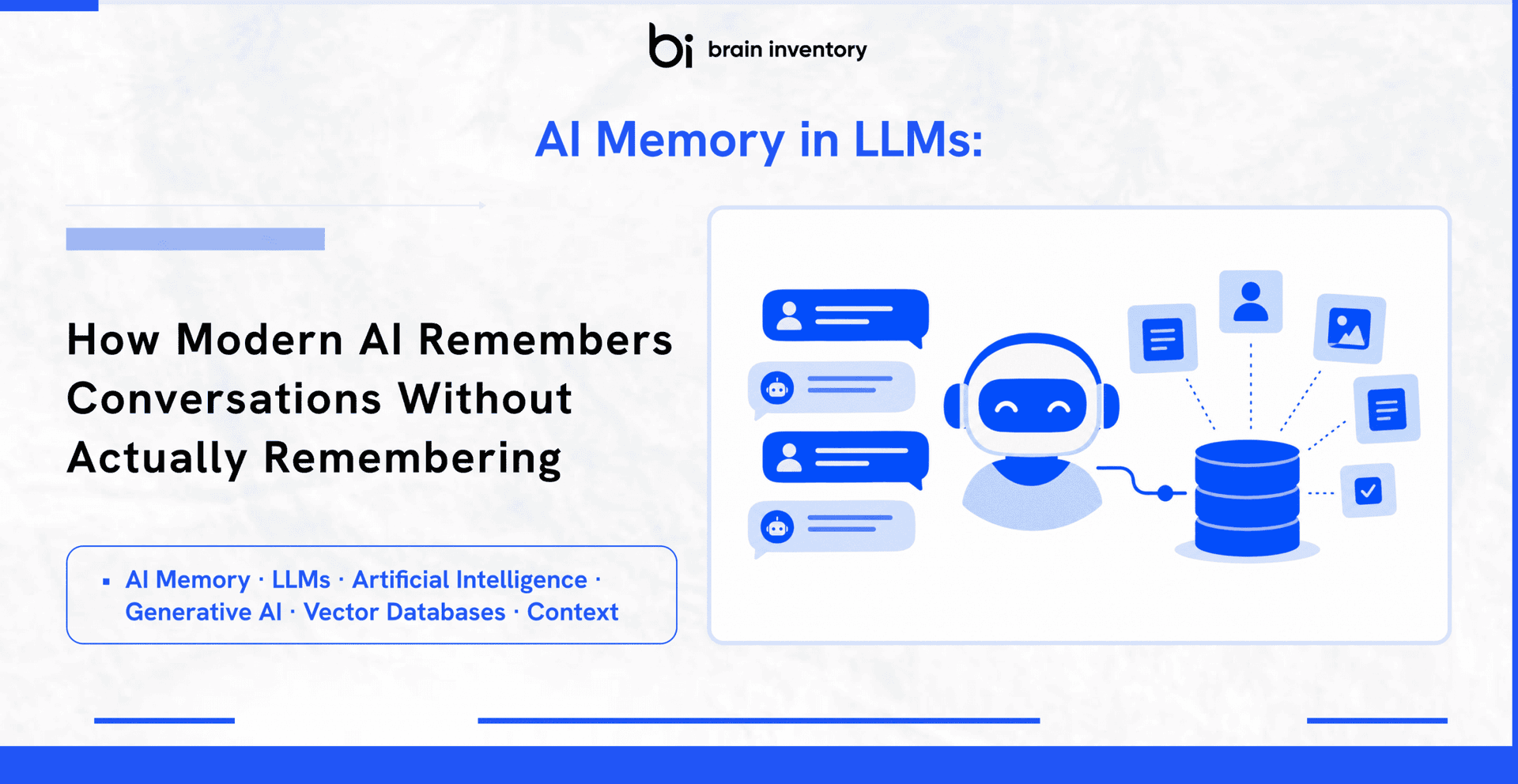
One major reason AI assistants feel more capable today is memory. Larger language models and better reasoning help, but memory also plays an important role.
Not long ago, every conversation with an AI assistant started from scratch. Whether you wrote code, brainstormed ideas, or prepared a report, you had to explain your project and requirements again. You often had to repeat your preferred way of working, too. The model could produce impressive responses during an active conversation. However, it did not automatically retain that information for your next session.
Today, AI assistants can continue projects, adapt to writing styles, and recall recurring preferences. These capabilities make conversations feel more natural and personal. But AI does not remember exactly as humans do. Large Language Models (LLMs) do not automatically learn from every interaction or permanently store every prompt inside their parameters.
Instead, AI memory in LLMs relies on systems that work alongside the language model. These systems decide what information to keep, where to store it, and when to retrieve it. This distinction matters when businesses build AI chatbots, coding assistants, customer support platforms, and productivity tools. A useful memory system can improve these applications without requiring a larger language model.
Large Language Models Are Stateless by Design
Many people assume that every AI conversation teaches the model something new. That assumption makes sense because modern AI often feels consistent during a conversation. An assistant can remember names mentioned minutes earlier, refer to previous answers, and build on earlier ideas. However, this consistency does not necessarily come from long-term memory.
How Stateless AI Conversations Work
An LLM generates a response using the information available in its current request. It does not automatically save every conversation, update its training, or permanently learn your preferences after answering.
Without an external system, the model cannot independently recall a previous session that its current input does not contain. Consider an experienced consultant. Before a meeting, you provide the consultant with business goals, meeting notes, customer feedback, and a product roadmap. These documents help the consultant make informed recommendations.
Now imagine inviting the same consultant back a week later without those documents. The consultant still has the same expertise but lacks the information needed to understand your latest situation. LLMs work similarly. Their reasoning capabilities remain available, but their answers depend on the information supplied with each request.
What Statelessness Means for AI Memory
AI engineers use the term stateless to describe interactions that do not automatically preserve conversational state. The term does not mean that a model lacks intelligence or cannot process context. It means that the application must provide relevant information from earlier interactions when it needs continuity. This is where context management and external memory systems become important.
Context and Memory Solve Two Different Problems
People often use the words context and memory interchangeably. However, these concepts serve different purposes in AI applications.
What Is a Context Window?
When you send a prompt to an AI model, the application gathers the information needed to generate a response. This may include your latest message, earlier messages, system instructions, uploaded documents, and information retrieved from external sources.
The context window defines how much information a model can process in a given interaction. Think of it as a temporary workspace that helps the model complete its current task.
Information inside the context window does not automatically become permanent memory. A larger context window lets a model process more information, but it does not guarantee that the application will preserve that information for future sessions.
How Long-Term Memory Differs
Memory helps an application preserve useful information across conversations. Examples include user preferences, ongoing projects, communication styles, and recurring tasks.
Imagine working at your desk. The documents spread across your desk represent context. Your notebook, containing months of meeting notes and client preferences, represents memory. You can clear your desk without throwing away your notebook. In the same way, an AI application can start a new conversation while keeping selected information available in an external memory store.
This distinction explains why advanced LLMs still need dedicated memory systems to support personalized experiences across multiple sessions.
Where Does AI Memory Actually Live?
In many AI applications, persistent memory lives outside the language model. Developers separate the model’s reasoning tasks from the application’s memory management. The language model interprets prompts and generates responses. A separate memory layer determines what to retain, how long to keep it, and when to retrieve it.
External Storage for AI Memory
Consider the information you share with an AI assistant over several weeks. You might mention your preferred programming language, current projects, writing style, and everyday software tools. Not every detail deserves long-term storage. A one-time weather question may have little future value. However, remembering that you build React applications could help the assistant provide more relevant technical advice.
AI applications can store useful information in several ways, including:
- Traditional databases for structured records.
- User profiles for preferences and recurring details.
- Document stores for project notes and reference material.
- Vector databases for semantic search and similarity-based retrieval.
How AI Retrieves Stored Information
When you return with another question, the application searches its memory stores. It retrieves relevant information and adds that information to the prompt sent to the language model. The model then uses the additional context to generate a response. From your perspective, the assistant may seem to remember the entire previous conversation.
In reality, the application may retrieve only a few relevant details. This approach can deliver continuity without sending every previous conversation to the model.
How AI Decides What to Remember
Saving everything might sound useful, but it can create more problems than it solves. Imagine a notebook containing every meeting, grocery list, temporary reminder, and random thought without any organization. Finding useful information would become difficult. AI memory systems face the same challenge as stored information grows.
Identifying Valuable Memories
Memory systems can prioritize information that improves future responses. Common examples include:
- User preferences and communication styles.
- Ongoing projects and business requirements.
- Frequently used programming languages and tools.
- Recurring tasks and long-term goals.
Applications may ignore temporary requests or remove outdated details. Their memory policies determine which information they retain and how long they keep it.
Updating Outdated or Conflicting Information
Good memory systems also update existing records. Suppose you previously told an assistant that your team uses Python. Later, you explain that your team has migrated to Go.
The application should recognize the change and update the relevant memory. Otherwise, it could retain conflicting information and generate less useful responses. Effective AI memory depends on relevance, accuracy, and timely retrieval. Simply storing more information does not guarantee better results.
Why Vector Databases Matter for AI Memory
After identifying useful information, an AI application must find it again when needed. Traditional databases work well for structured information, but conversations often rely on meaning rather than exact keywords.
Understanding Semantic Search
Suppose you previously told an AI assistant that you build backend applications with Node.js. A few weeks later, you ask which object-relational mapping (ORM) tool would suit your next project. Your new question does not mention Node.js, but your earlier discussion could still help the assistant answer. A basic keyword search might miss this connection because the two conversations use different words.
How Embeddings Help Retrieve Memories
Vector databases support similarity searches using mathematical representations called embeddings. An embedding model converts text or other information into numerical vectors that can capture semantic relationships.
The application can compare these representations to find information related to a new question. For example, a question about ORMs may retrieve a previous memory about Node.js development.
The application then supplies the relevant memory to the language model as additional context.
Vector databases have therefore become important components of many AI memory architectures. However, retrieval quality also depends on embedding models, indexing strategies, metadata filters, and ranking methods.
AI Memory Is More Than Conversation History
AI memory is not simply a collection of previous chats. Conversation history helps, but replaying months of chat logs for every new question would waste resources and introduce irrelevant information.
Summaries and Structured Memory
Modern AI applications can organize information into useful forms. They may summarize long conversations, store recurring preferences in user profiles, or index project knowledge separately.
This structure helps the application retrieve information only when a request needs it. It also prevents unrelated conversation details from overwhelming the model’s context.
Improving Efficiency and Relevance
Selective memory can reduce unnecessary token usage and help applications manage long-running projects. It can also support faster responses when the system retrieves concise, relevant information instead of entire conversation histories.
The goal is simple: maintain useful continuity without including every previous interaction in every new prompt.
Retrieving the Right Memory Is Just as Important as Storing It
Even a sophisticated memory system can fail when it retrieves irrelevant information. Imagine asking an AI assistant about a software architecture decision, only for it to retrieve an unrelated marketing discussion from several months ago.
The assistant has retrieved a memory, but that memory does not help answer the question.
How AI Ranks Relevant Memories
When a new request arrives, the application evaluates potential memories before selecting the most relevant ones. Semantic similarity often plays an important role, but other factors can also improve the result.
The system may consider:
- Relevance: How closely the memory relates to the current question.
- Recency: How recently the information was created or updated.
- Importance: Whether the application marked the memory as valuable.
- Project context: Whether the information belongs to the current task or workflow.
Some applications also use metadata filters, reranking, and time-based rules. These techniques help prioritize information that best matches the current request.
Why Retrieval Quality Matters
After ranking the available memories, the application selects useful information and includes it in the prompt. The language model then uses that context to generate a more informed response.
This process can happen quickly, but it has a major impact on conversation quality. An assistant needs more than a large memory store. It needs to retrieve the right information at the right moment.
Build Smarter AI Applications with Brain Inventory
AI memory plays an important role in personalized assistants, coding tools, enterprise chatbots, and customer support platforms. Building these experiences requires more than choosing a powerful language model.
Businesses also need effective memory storage, context management, information retrieval, and data protection strategies. The right architecture can improve usability, scalability, and performance.
Brain Inventory helps businesses explore AI development and custom software solutions that align with their goals. Whether you want to build a conversational AI assistant, an intelligent automation platform, or an AI-powered business application, a well-planned architecture can help turn your idea into a practical solution.
Ready to build an AI solution for your business? Contact Brain Inventory to discuss your requirements and explore AI-powered solutions tailored to your business objectives.

Have an idea?
Get in touch, we’d be
happy to hear from you
We are always looking out for new collaborations, whether you are a client who is passionate about a project or a talent who is interested in joining our team, our doors are always open.
locate us

India (HQ)
618, Shekhar Central, Palasia Square, A.B Road, Indore, Madhya Pradesh, 452001
+918109561401

United Kingdom
Brain Inventory, SBVS, 8 Roundhay Road, Leeds, UK, LS7 1AB
+18008209286

Canada
44 Main Street East Milton, ONCanada L9T 1N3
+4166696505

Jordan
185 Wasfi Al-Tal Street, Ammon Oasis Complex P.O Box 4724 Amman 11953 Jordan
+960770781000

USA
720 Seneca St Ste 107 Seattle, USA 98101
+1(206)6533419
if it's digital,we'll make it.
- Numetric - Online Accounting Software similar to QuickBooks
- Bloomia - Kegel exercise
- Virifi - Blockchain Powered Document Certification & Signing Platform
- Revolution Travel CRM - Custom CRM Built for Travel Agents
- Fatoura - Online Invoicing Platform
- My Fit Mantra - Your health partner
- Ocureel - Relation Building and video sharing Application




Follow us:


