Artificial intelligence has become remarkably good at understanding and generating language. Today’s Large Language Models (LLMs) can summarise documents, write code, draft emails and answer complex questions. They have changed how people interact with technology. However, LLMs once had a major limitation. They could explain how to complete a task, but they could not perform it on their own.
Ask an AI assistant to send an email, schedule a meeting or retrieve sales figures. In many cases, the assistant would explain what to do instead of taking action. Function calling has changed this experience. Modern AI applications can now connect with business systems, retrieve live information and trigger workflows through external tools. Understanding AI function calling helps explain the growth of enterprise AI, AI copilots and intelligent AI agents. It also shows why today’s AI applications can do much more than traditional chatbots.
The Biggest Misconception About AI
When an AI assistant books a meeting or retrieves customer information from a CRM, it may seem as though the language model directly controls those applications. In reality, the process works differently. A Large Language Model cannot automatically access your calendar, log into enterprise software, query a database or process financial transactions. Developers must connect the model to suitable tools and services. The model focuses on understanding language, identifying patterns and reasoning over information.
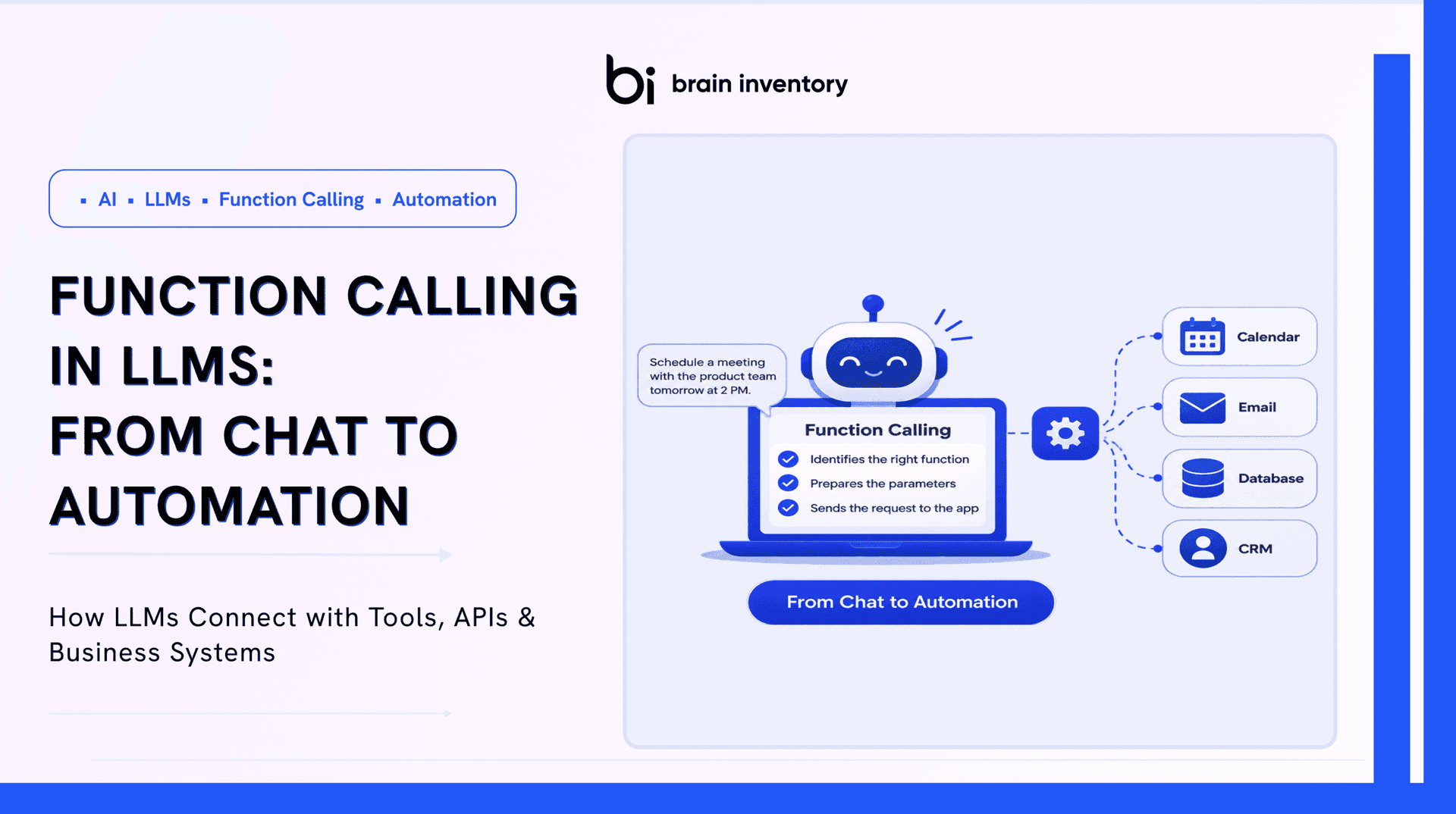
Consider this request: “Schedule a meeting with the product team tomorrow at 2 PM.” The model can understand the request, identify the participants and recognise the intended time. It can also suggest a meeting title. However, creating the meeting requires calendar access, authentication and communication with an external application. The surrounding software handles these tasks. This difference between understanding a request and carrying it out explains why function calling matters.
What Is AI Function Calling and How Does It Work?
AI function calling allows a Large Language Model to recognise when a request needs an external tool. The model then generates a structured request that describes the intended action and its required parameters. The model does not execute the function itself. Instead, it identifies a suitable function and provides the information that the application needs. The application validates the request and calls the relevant API or business system. It then returns the result to the model, which explains the outcome in natural language.
Imagine asking an AI assistant to find customers who have not renewed their subscriptions in the past month and send them reminder emails. This request involves several steps. The application must retrieve customer records, identify eligible customers, prepare reminder messages and send them through an email service. The language model helps coordinate these steps, while the connected systems perform the actual operations. That is why function calling serves as an orchestration capability. It helps AI applications coordinate tools without giving the language model direct control over every operation.
Function Calling vs API Calling
People often use function calling and API calling interchangeably. However, the two serve different purposes. An Application Programming Interface (API) allows software applications to communicate. It defines how systems send requests, exchange data and receive responses. APIs also support operations such as retrieving records or updating information.
Function calling helps the language model decide when to use an available function. It also helps the model select the appropriate tool and provide the required parameters. For example, imagine asking an AI assistant to retrieve today’s sales report. The model may recognise that it needs sales data and select a function that retrieves the report. The application then checks permissions, sends the API request and returns the data. The model can use that result to explain the sales figures. This separation helps developers maintain control over authentication, permissions and business logic.
Why Function Calling Powers Enterprise AI
Enterprise AI needs more than strong text generation. It also needs reliable access to business systems. A customer support assistant needs order history to help resolve a refund request. An HR assistant needs current leave balances to answer employee questions. A finance copilot needs transaction data to prepare useful reports. In each case, the model needs information or capabilities beyond its own language knowledge. Function calling helps the application access those resources while keeping the model focused on understanding requests and coordinating the next steps.
Function calling also supports modern AI agents. Traditional chatbots usually answer individual questions. AI agents can coordinate several actions to achieve a broader goal. For example, a travel assistant might search for flights, compare hotels, check weather conditions, update a calendar and prepare an itinerary. Each task may require a different tool or service. Function calling helps the agent coordinate these interactions. The connected applications handle reservations, calendar changes and other operations according to their permissions and rules.
Function Calling Does Not Work Alone
Function calling plays an important role in AI applications, but it does not solve every problem. Other technologies help AI systems retrieve information, maintain context and connect with external tools. Consider an employee who asks, “How many leave days do I have left?” The assistant may use function calling to retrieve current information from an HR system.
Now consider a different question: “What is our company’s parental leave policy?” The assistant needs relevant information from internal documents. Retrieval-Augmented Generation (RAG) helps by retrieving useful content before the model generates its answer. AI memory can help an assistant retain relevant conversation context and user preferences when the application supports that capability. Meanwhile, the Model Context Protocol (MCP) provides a standard way for AI applications to connect with external tools and data sources.
These technologies serve different purposes. Function calling coordinates actions, RAG retrieves relevant information, memory supports continuity and MCP standardises connections with compatible tools and resources. When developers combine these capabilities appropriately, they can build AI applications that understand requests, retrieve information and coordinate business workflows.
Challenges and Security Considerations
Giving AI access to external tools introduces new engineering challenges. As developers add more functions, the model may find it harder to select the right one. Incorrect selections or missing parameters can cause failed workflows and unexpected results. Security also requires careful planning. AI assistants may interact with sensitive business systems, customer records and financial information. Organisations must protect these resources with appropriate safeguards.
Role-based access control helps restrict actions to authorised users. Parameter validation catches incomplete or invalid requests. Approval workflows add human oversight to high-risk operations, while audit logs help teams track important actions. Developers should validate every function request before execution. They should also enforce permissions, protect sensitive information and require approval when necessary. These controls help organisations balance AI capabilities with security, accountability and reliability.
Conclusion: Function Calling Is Changing What AI Can Do
Large Language Models have transformed how people communicate with machines. Function calling expands what AI applications can accomplish. With the right tools, AI applications can retrieve live information, coordinate external services and trigger business workflows. The model interprets the user’s intent and selects suitable actions. Connected applications then execute those actions under established rules and permissions.
As organisations adopt AI, choosing a powerful language model is only one part of the process. They also need a reliable architecture that connects AI with business data, APIs and operational systems. Function calling, RAG, memory and MCP can each contribute to that architecture. Developers must choose and configure these technologies according to their specific needs. The future of AI will depend on more than how well models communicate. It will also depend on how effectively they help people complete real tasks.
Build Smarter AI Solutions with Brain Inventory
At Brain Inventory, we believe the true value of AI lies in solving practical business challenges. From intelligent automation to AI-powered workflows, businesses can use the right technologies to reduce repetitive work and improve operational efficiency.
Want to explore how AI function calling, intelligent agents and business integrations could support your organisation? Connect with Brain Inventory to discuss your goals and identify opportunities to make your workflows smarter.
Ready to take the next step with AI? Get in touch with Brain Inventory and explore smarter solutions for your business.