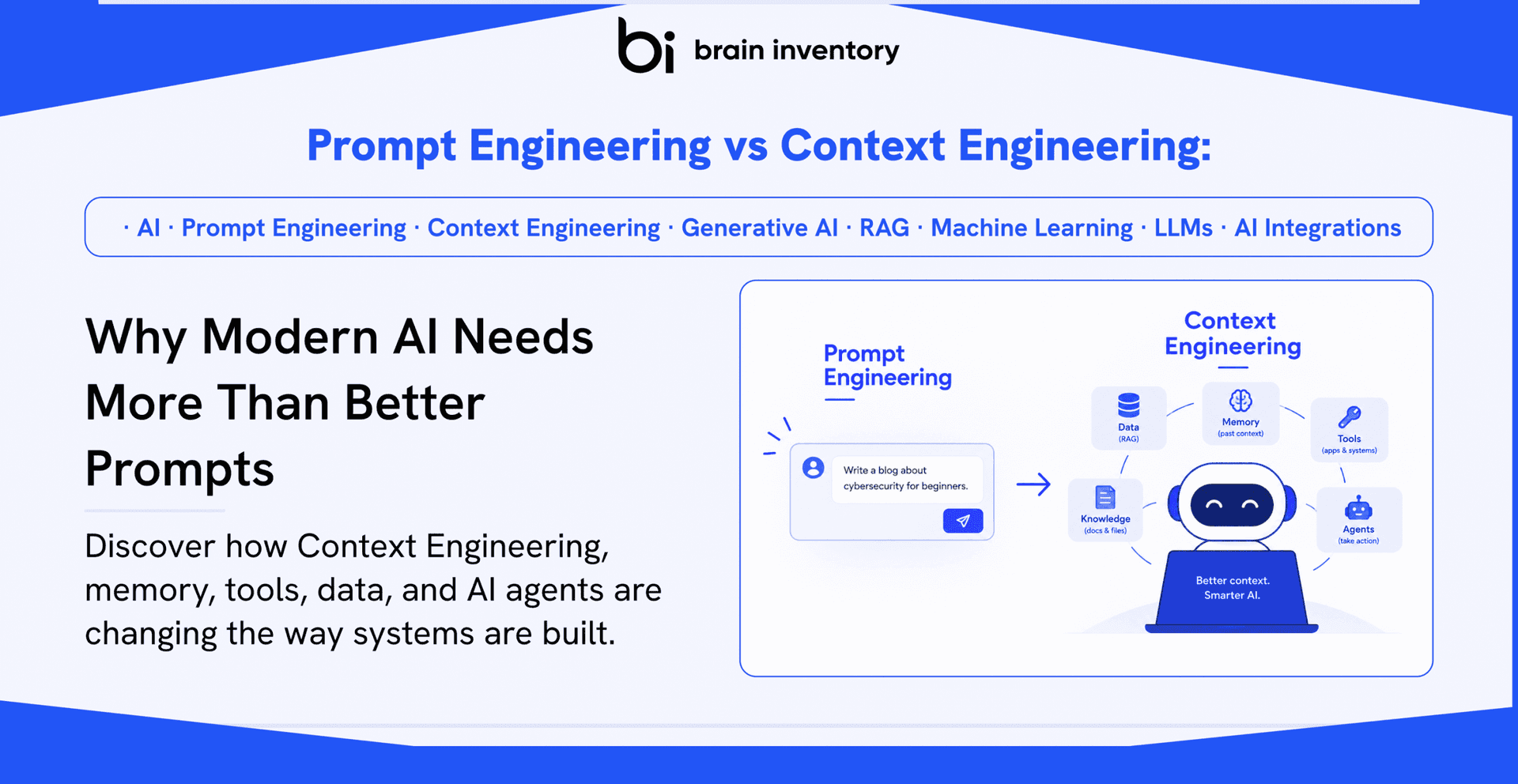
Artificial intelligence has evolved rapidly. For a long time, one skill dominated conversations about using AI effectively: Prompt Engineering. People used it to generate content, write code, build chatbots, and automate everyday tasks. The quality of their results often depended on how clearly they instructed a language model.
Prompt Engineering remains valuable, but modern AI applications need more than prompts. They retrieve information from knowledge bases, remember relevant interactions, connect with external tools, and execute complex workflows. This shift has brought Context Engineering into focus.
Understanding Prompt Engineering vs Context Engineering is essential for businesses and developers building reliable AI solutions. Prompt Engineering focuses on what you tell the model. Context Engineering focuses on the information, tools, and resources available to it.
What Is Prompt Engineering?
Prompt Engineering is the practice of designing clear instructions that guide an AI model toward a desired outcome. Large language models generate responses based on their training and the input they receive. Vague instructions can therefore produce generic or inconsistent results.
For example, asking an AI to write a cybersecurity blog may generate a broad article. Providing the target audience, tone, word count, keywords, and preferred structure can produce a more relevant result.
Common Prompt Engineering Techniques
Several techniques help improve prompts. Role prompting establishes the perspective the model should adopt. Few-shot prompting provides examples of the expected output. Structured instructions define the format, constraints, and evaluation criteria.
Breaking a complex task into smaller steps can also make it easier to manage. These techniques are useful for content creation, research, summarization, coding assistance, translation, and brainstorming.
However, prompts have limitations. A carefully written instruction cannot automatically provide access to private company data. It also cannot retrieve current information or execute external actions unless the application supports those capabilities.
Why Better Prompts Are No Longer Enough
Consider a business that wants to automate customer refund requests. A well-designed prompt can help an AI assistant explain the refund policy and draft a professional response. A production-ready system, however, may need to do much more.
From Generating Responses to Completing Tasks
The system might identify the customer, retrieve order details, verify eligibility, and check company policies. It may then update records, initiate an approved refund, and notify the customer.
Each step requires information and functionality beyond the original prompt. The model needs access to relevant systems and must operate within defined permissions.
Why Business Context Matters
The same challenge appears across industries. A coding assistant needs access to the relevant codebase and documentation. A financial application needs current market data and appropriate customer information. A business support agent may need customer records, internal policies, and ticketing software.
In these situations, the model’s effectiveness depends on more than its instructions. It also depends on whether it has the right context. This is where Context Engineering becomes essential.
What Is Context Engineering?
Context Engineering involves designing the information and operating environment available to an AI model. Instead of focusing exclusively on instructions, it ensures the model receives relevant, accurate, and timely information.
Think of a new employee joining an organization. Their skills matter, but they also need company documentation, customer information, internal tools, and an understanding of business processes. Without these resources, even an experienced employee may struggle to make informed decisions.
AI systems work similarly. Before generating a response, an application may retrieve documents, query databases, load selected user preferences, access APIs, and apply business rules. The model can then work with information specific to the task.
Choosing the Right Context
Context Engineering also involves deciding which information to include and what to exclude. Developers must determine how information should be prioritized and when additional data should be retrieved.
More information does not always produce better results. Irrelevant or contradictory context can confuse a model, increase processing costs, and reduce response quality.
An effective context strategy balances relevance, accuracy, freshness, security, and efficiency. It gives the model enough information to perform its task without overwhelming it with unnecessary data.
Prompt Engineering vs Context Engineering: Key Differences
These disciplines solve related but different problems. The following comparison highlights their main differences.
| Aspect | Prompt Engineering | Context Engineering |
|---|---|---|
| Primary focus | Instructions and task definition | Information and resources available to the model |
| Main objective | Improve output quality and instruction following | Support informed, context-aware task execution |
| Typical inputs | Questions, examples, roles, and constraints | Documents, memory, databases, APIs, and tool results |
| Common applications | Writing, summarization, coding, and brainstorming | AI agents, enterprise assistants, and automation |
| Key challenge | Reducing ambiguity and improving instructions | Providing relevant, reliable, and secure context |
| Relationship | Defines what the model should do | Helps provide what the model needs to do it |
These approaches are complementary, not competing disciplines. Prompt Engineering communicates the objective. Context Engineering helps provide the information and capabilities needed to achieve it.
How AI Agents Are Changing the Landscape
AI agents have accelerated the shift from individual prompts toward complete AI workflows. Traditional assistants primarily answer questions. AI agents can be designed to pursue goals through multiple steps.
AI Agents in Real-World Applications
Depending on their configuration, agents can break tasks into smaller actions, retrieve information, select tools, and evaluate intermediate results. They can also adjust their approach as new information becomes available.
For example, an AI recruitment agent could analyze a job description and search a candidate database. It could compare resumes against required skills and prepare candidate summaries. With suitable integrations, it could also coordinate interview scheduling.
A sales agent might retrieve account history, summarize previous conversations, and prepare a personalized follow-up. A software development agent could inspect project files, suggest code changes, and run tests through approved tools.
Why Agents Need Context Engineering
These capabilities require access to multiple systems. They also need reliable coordination between those systems. A prompt can describe the objective, but the application must provide the data, tools, permissions, and workflow logic.
Agentic systems also need safeguards. Tool outputs must be checked, and sensitive actions may require human approval. Applications should limit what an agent can access or modify.
Context Engineering helps determine which information and capabilities are available at each stage of the workflow.
Four Technologies Powering Context-Aware AI
Several technologies help transform language models into useful components of larger AI applications. Each addresses a different limitation. Together, they support more capable and context-aware workflows.
1. Retrieval-Augmented Generation (RAG)
Retrieval-Augmented Generation allows AI applications to retrieve relevant information from external sources before generating a response. These sources may include company documents, knowledge bases, product information, or databases.
For example, an internal HR assistant can retrieve the latest leave policies before answering an employee’s question. The application supplies relevant policy information as context instead of relying entirely on general training data.
RAG can improve factual grounding and make responses more relevant to an organization. Its effectiveness depends on retrieval quality, source freshness, access permissions, and how well the model uses the retrieved content.
2. AI Memory
AI memory enables applications to retain selected information across interactions. A support assistant might reference previous tickets. A coding assistant could use earlier project decisions to maintain continuity.
Memory may include user preferences, project details, or summaries of earlier work. The application must determine what is worth retaining and when that information should be retrieved.
Memory can improve personalization and reduce repetitive questions. However, it needs appropriate privacy protections, retention policies, and user controls. Stored information should also be reviewed for accuracy and relevance.
3. Function Calling and Tool Use
Function calling allows a language model to request actions through predefined tools connected to an application. An AI assistant might check calendar availability, retrieve customer details, or request the creation of a support ticket.
The application remains responsible for validating requests, enforcing permissions, and handling errors. Sensitive operations may also require approval.
Well-designed tool integrations should describe available functions clearly, validate input parameters, and return useful results. These measures help reduce errors and make AI-driven actions easier to monitor.
4. Model Context Protocol (MCP)
The Model Context Protocol provides a standardized way for compatible AI applications to connect with external tools and context providers. It can simplify integrations and help connect AI systems with different data sources and services.
For organizations working with multiple applications, standardized connections can reduce the effort involved in building and maintaining integrations.
MCP does not automatically guarantee compatibility or eliminate security risks. Authentication, authorization, access controls, and validation remain essential when connecting AI applications to business systems.
Together, these technologies help AI applications retrieve information, maintain relevant context, interact with tools, and support complex workflows.
AI Workflow Architecture Is the Real Competitive Advantage
In a basic AI application, a user submits a prompt, the model generates a response, and the application returns the result. Production-ready systems often involve a much broader process.
How a Modern AI Workflow Operates
Before the model responds, an application may retrieve documents, validate permissions, load relevant preferences, and collect information from databases. It may also determine which tools are appropriate for the task.
Afterward, the system may validate the output, check business rules, request human approval, or execute an authorized action. Each component contributes to the final result.
For example, a customer support workflow might retrieve previous interactions and identify the applicable policy. It could then draft a response, check the answer against approved information, and escalate complex cases to a human employee.
Why Architecture Creates Business Value
This approach is known as AI workflow architecture. It considers how retrieval, memory, reasoning, tool use, evaluation, monitoring, and execution work together throughout the AI lifecycle.
Two companies can use the same language model and still deliver very different results. Their performance depends on data quality, integration reliability, security controls, workflow design, and evaluation processes.
For businesses, adopting a powerful model is only the beginning. Building a reliable system around that model makes AI more useful in real-world operations.
Challenges in Implementing Context Engineering
Context Engineering can improve AI applications, but implementing it effectively requires careful planning. Organizations must address several technical and operational challenges.
Data Quality and Relevance
Outdated documents, duplicated records, and conflicting information can lead to poor results. Organizations need reliable data sources and processes for updating, organizing, and retrieving information.
Security and Privacy
AI applications may interact with confidential business information or personal data. Access controls should ensure that models retrieve only information the requesting user or process is authorized to access.
Context Management and Cost
Large amounts of context can increase processing costs and introduce irrelevant information. Systems should prioritize useful content, retrieve information when needed, and manage context within model limits.
Testing and Reliability
AI systems should be evaluated using realistic tasks. Testing should include missing information, conflicting documents, tool failures, and unauthorized requests.
Monitoring and feedback help teams identify weaknesses and improve performance. These processes are particularly important when AI systems support business-critical operations.
Skills Needed to Build Modern AI Applications
Prompt Engineering is not becoming obsolete. Clear instructions remain important for reducing ambiguity, defining constraints, and improving AI-generated outputs.
However, developers building production-ready AI applications need a broader skill set. Alongside prompt design, they should understand Context Engineering, RAG, AI agents, memory systems, function calling, workflow orchestration, evaluation, and security.
Measuring AI Performance
Teams must also understand how to measure performance. A useful AI system should be evaluated for accuracy, relevance, response time, operational cost, and its ability to complete tasks correctly.
Applications that take action may require permission checks and human oversight. These safeguards help ensure that the system operates within defined business rules.
A well-written prompt cannot compensate for outdated data, poor retrieval, missing permissions, or unreliable integrations. Likewise, a sophisticated AI architecture still benefits from clear instructions and well-defined objectives.
The most effective approach combines strong prompt design with carefully engineered context and dependable system architecture.
Final Thoughts: The Future of AI Goes Beyond Better Prompts
The evolution of artificial intelligence is changing how businesses approach technology, automation, and digital innovation. What began as a way to generate text and answer questions is developing into a broader ecosystem of intelligent applications. These systems can retrieve information, analyze data, interact with external tools, and support complex workflows.
Prompt Engineering played an important role in this transformation. It showed developers, businesses, and everyday users how clear instructions could improve the performance of large language models. Well-designed prompts remain essential for defining objectives, setting expectations, and guiding AI toward useful results.
Why Context Is Becoming More Important
As organizations move from AI experimentation to practical implementation, the limitations of prompt-only approaches become increasingly apparent. An AI application cannot make reliable decisions if it lacks relevant information, current business data, appropriate tools, or the rules that govern its actions.
Context Engineering addresses this challenge by combining relevant data, retrieval systems, memory, APIs, tool integrations, and workflow orchestration. These capabilities help applications use information that is specific to the task. They also make it possible to build workflows that go beyond generating a single response.
The distinction between Prompt Engineering and Context Engineering is not about choosing one over the other. Both serve complementary purposes. Prompt Engineering communicates the task, while Context Engineering helps provide the information and capabilities needed to complete it effectively.
What Businesses Should Focus On Next
For developers and technology leaders, this shift creates an opportunity to expand their technical capabilities. Understanding how language models interact with knowledge bases, AI agents, memory systems, and external tools is becoming increasingly important.
Security, data privacy, reliability, and human oversight also matter. These considerations become especially important when AI systems handle sensitive information or support business-critical operations.
For businesses, adopting AI should involve more than selecting a powerful model or experimenting with prompts. Successful implementation requires identifying the right use cases, organizing reliable data, designing effective workflows, and measuring business outcomes.
Organizations that approach AI strategically can improve operational efficiency, support better decision-making, enhance customer experiences, and reduce repetitive manual work. Achieving these outcomes requires thoughtful engineering rather than relying on a language model alone.
Ultimately, the future of AI will be shaped by how effectively organizations combine capable models with relevant context, dependable integrations, and well-designed workflows.
The real opportunity lies not simply in asking AI better questions, but in building systems that give AI the right information, the right tools, and the right boundaries to solve meaningful problems.
Ready to Turn Your AI Ideas Into Business Solutions?
Moving from AI experimentation to practical implementation requires the right strategy, technology, and development expertise. Whether you want to streamline business operations, build an intelligent AI assistant, automate repetitive workflows, or integrate AI into an existing application, the right development partner can help you move forward.
Build AI Around Your Business Needs
Brain Inventory helps businesses explore and develop digital solutions tailored to their operational needs and long-term goals. From custom software development to AI-powered applications and intelligent workflow automation, our focus is on turning technology opportunities into practical solutions.
We can help you explore suitable AI use cases, evaluate implementation approaches, connect relevant data sources, and plan solutions around your business requirements. The objective is not to introduce AI simply for the sake of innovation. It is to identify where AI can make a meaningful difference.
Take the Next Step Toward Smarter AI
Whether you are exploring your first AI initiative or expanding an existing AI ecosystem, start by identifying the problem you want to solve and the outcomes you want to achieve.
With the right combination of AI models, context, integrations, and workflow design, your business can move beyond basic AI interactions toward more useful and scalable solutions.
Let’s explore what’s possible for your business.
Contact Brain Inventory to discuss your AI development project and discover how custom AI solutions, intelligent agents, and workflow automation can support your next stage of growth.