SLM vs LLM: Key Differences, Benefits & Use Cases
When ChatGPT first captured the world’s attention, many people assumed that the future of artificial intelligence would simply be about building bigger and bigger models. Large Language Models (LLMs) demonstrated impressive capabilities by generating human-like text, writing code, solving complex problems, and understanding natural language. As newer models introduced billions or even hundreds of billions of parameters, it became easy to believe that model size alone determined intelligence.
However, the AI landscape has evolved considerably. Instead of relying exclusively on increasingly massive models, many organizations are adopting Small Language Models (SLMs) to automate customer support, streamline internal workflows, power AI assistants on edge devices, and support enterprise AI systems. This shift is not simply about reducing costs. For many real-world applications, smaller models provide a more practical and efficient solution.
The discussion around SLM vs LLM has therefore changed significantly. Rather than asking which model is bigger, organizations are asking which model is most suitable for a particular task. Choosing the right model for the right workload has become more important than choosing the model with the highest parameter count.
Understanding the Difference Between SLMs and LLMs
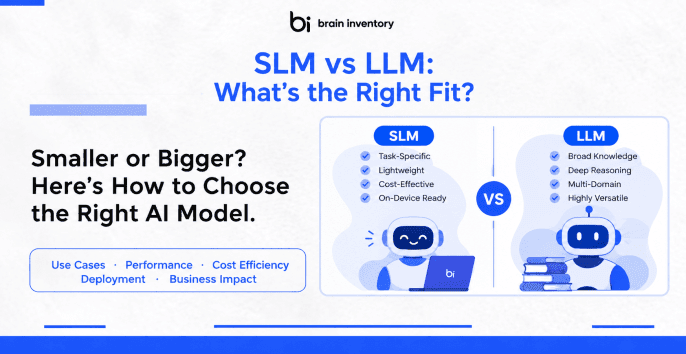
Both Small Language Models and Large Language Models are designed to understand and generate human language. They often use similar deep learning techniques and transformer architectures, but differ in scale, optimization, computational requirements, and intended use.
Large Language Models are trained on extensive datasets and can contain billions or even hundreds of billions of parameters. Their broad training enables them to perform a wide range of tasks, including creative writing, complex reasoning, coding assistance, research, and conversations across multiple subjects.
Small Language Models take a more focused approach. They are designed to perform efficiently with fewer computational resources and can be optimized through fine-tuning, domain-specific training, and knowledge distillation. These techniques help SLMs deliver strong results for specific business problems.
Parameter count alone does not determine model quality. Performance also depends on training data, architecture, optimization techniques, and how well the model fits the task. Using an extremely large model for a simple workflow can be unnecessary and inefficient.
Why Bigger Models Don’t Always Deliver Better Results
Increasing the number of parameters can improve a model’s capabilities, but it also introduces practical trade-offs. Large models typically require more computing power, memory, and infrastructure investment. Depending on the deployment, they may also introduce higher latency and operating costs.
For organizations that need to classify support tickets, summarize documents, process invoices, or extract structured information, a frontier-scale model may offer more capability than the application actually requires.
This is where Small Language Models demonstrate their value. One technique used to develop compact models is knowledge distillation, in which a smaller student model learns from the outputs or behavior of a larger teacher model. This can help the smaller model retain useful capabilities while requiring fewer computational resources.
The result can be a fast, cost-effective AI system that performs well on specialized tasks. A useful analogy is hiring a specialist rather than a generalist: the specialist may deliver better results for a narrowly defined responsibility, even if the generalist has broader knowledge.
Where Small Language Models Excel
For most businesses, the question is not whether an SLM is universally better than an LLM. It is whether an SLM is better suited to a particular business function.
Small Language Models are especially useful when speed, efficiency, privacy, and operational cost are important priorities. Their smaller resource footprint can make them suitable for applications that require frequent, predictable, and relatively focused responses.
Common business applications include:
- Customer support automation and FAQ responses
- Document classification and information extraction
- Invoice and form processing
- Medical coding assistance and structured data workflows
- Internal knowledge search and IT ticket routing
- Fraud detection support and text classification
- AI assistants running on laptops, smartphones, and edge devices
Deployment flexibility is another advantage. Organizations may prefer to keep sensitive information within their own infrastructure rather than sending it to external cloud-based AI services. Depending on hardware and model requirements, SLMs can be deployed on-premises or on edge devices, giving businesses greater control over data handling and system architecture.
Smaller models can also reduce inference costs by lowering compute requirements. The actual savings depend on model performance, hardware, traffic volume, and deployment architecture, but efficient models can help businesses expand AI adoption without proportionally increasing infrastructure expenses.
Where Large Language Models Continue to Lead
Despite the growing adoption of SLMs, Large Language Models remain valuable for advanced AI applications. Their extensive training can support broad knowledge, complex reasoning, creative generation, and contextual understanding across different subjects.
LLMs are particularly useful for:
- Complex research and information synthesis
- Long-form content generation and editing
- Advanced coding assistance and debugging
- Multi-step reasoning and complex problem-solving
- Strategic planning and open-ended conversations
- Tasks that require combining information across multiple domains
For applications where adaptability and broad capabilities matter more than inference cost or response time, LLMs may be the more appropriate option. Their flexibility makes them useful for tasks that are difficult to define in advance or that involve changing requirements.
Comparing SLMs and LLMs as direct competitors therefore oversimplifies the issue. The right choice depends on the complexity of the task, the required accuracy, available infrastructure, security requirements, and the cost of operating the system.
SLM vs LLM: Key Differences at a Glance
| Comparison Factor | Small Language Models (SLMs) | Large Language Models (LLMs) |
|---|---|---|
| Model scale | Generally fewer parameters | Generally more parameters |
| Computational requirements | Typically lower | Typically higher |
| Inference cost | Often lower for comparable workloads | Can be higher, depending on usage |
| Response speed | Often well suited to low-latency tasks | Depends on model size, serving setup, and workload |
| Knowledge breadth | Can be more focused or limited | Generally broader across domains |
| Specialized workflows | Strong fit when appropriately optimized | Can also perform well, sometimes with unnecessary overhead |
| Complex reasoning | Depends on model capabilities and task complexity | Often better suited to demanding reasoning tasks |
| Edge deployment | Often more practical on resource-constrained devices | May require more powerful hardware or cloud infrastructure |
These differences are general tendencies rather than universal rules. A well-optimized small model can outperform a larger model on a specific task, while a larger model may be necessary for applications that demand broader knowledge or more sophisticated reasoning.
Why Modern AI Systems Combine Both Models
One of the most important developments in enterprise AI is not replacing Large Language Models with Small Language Models, but combining them within a single architecture.
Hybrid AI systems assign different responsibilities to different models based on their strengths. Consider a customer support chatbot. An SLM can identify customer intent, retrieve relevant company information, and resolve routine questions. When a conversation becomes more complex or requires deeper reasoning, the system can route the request to an LLM.
This approach can reduce latency and operating costs by reserving larger models for tasks that genuinely require their capabilities. However, its effectiveness depends on routing accuracy, the quality of the smaller model, integration complexity, and the cost of switching between models.
The same principle applies to enterprise AI agents. Smaller specialized models can handle repetitive operations, classify requests, and extract information, while larger models focus on complex reasoning and decision support.
By combining models strategically, businesses can build AI systems that balance performance, scalability, cost, and flexibility instead of relying on a single model for every task.
The Future of AI Is About Smarter Deployment, Not Bigger Models
For years, the AI industry often measured progress by model size and parameter count. Today, organizations are increasingly evaluating AI systems based on practical business outcomes.
Businesses want to know whether a model can run locally, protect sensitive information, reduce infrastructure expenses, deliver timely responses, and integrate with existing workflows.
These priorities are contributing to the adoption of Edge AI, specialized language models, and hybrid AI architectures. Rather than selecting a model solely because it is larger or newer, organizations are assessing its suitability for their specific requirements.
Small Language Models are becoming an important part of modern AI ecosystems alongside LLMs. Each approach serves different needs, and combining them can create systems that are more efficient and better aligned with real-world business requirements.
Conclusion
The belief that larger AI models are always better is giving way to a more practical understanding of artificial intelligence. Large Language Models continue to offer valuable capabilities for complex reasoning, creative generation, and broad knowledge. However, many everyday business applications do not require that level of capability.
Small Language Models show how specialization and optimization can deliver effective results for focused business problems while potentially reducing computational requirements and operating costs. Organizations that evaluate models based on task complexity, accuracy, privacy, infrastructure, and budget are better positioned to build sustainable AI solutions.
Ultimately, the future of AI is not about choosing between SLMs and LLMs. It is about understanding where each model delivers the greatest value and combining them intelligently to solve real business challenges.
Build Smarter AI Solutions with Brain Inventory
Choosing between Small Language Models and Large Language Models is only one part of building an effective AI solution. The right strategy also depends on your business goals, data infrastructure, integration requirements, security needs, and long-term scalability.
Brain Inventory can help your business explore AI development opportunities and identify practical approaches to automation, intelligent applications, and enterprise AI integration.
Ready to turn your AI ideas into business results? Connect with Brain Inventory to discuss your AI development needs and explore solutions tailored to your business.

Have an idea?
Get in touch, we’d be
happy to hear from you
We are always looking out for new collaborations, whether you are a client who is passionate about a project or a talent who is interested in joining our team, our doors are always open.
locate us

India (HQ)
618, Shekhar Central, Palasia Square, A.B Road, Indore, Madhya Pradesh, 452001
+918109561401

United Kingdom
Brain Inventory, SBVS, 8 Roundhay Road, Leeds, UK, LS7 1AB
+18008209286

Canada
44 Main Street East Milton, ONCanada L9T 1N3
+4166696505

Jordan
185 Wasfi Al-Tal Street, Ammon Oasis Complex P.O Box 4724 Amman 11953 Jordan
+960770781000

USA
720 Seneca St Ste 107 Seattle, USA 98101
+1(206)6533419
if it's digital,we'll make it.
- Numetric - Online Accounting Software similar to QuickBooks
- Bloomia - Kegel exercise
- Virifi - Blockchain Powered Document Certification & Signing Platform
- Revolution Travel CRM - Custom CRM Built for Travel Agents
- Fatoura - Online Invoicing Platform
- My Fit Mantra - Your health partner
- Ocureel - Relation Building and video sharing Application




Follow us:


